How do I enable checkout in Google AI Mode, and can I advertise there?
You can advertise now: Shopping ads have run in AI Mode since February 11, 2026, served from Shopping and Performance Max campaigns connected to Merchant Center. Checkout runs on the Universal Commerce Protocol, is US-only and open to selected merchants who add the native_commerce attribute to their feed and submit an interest form.
Key takeaways
- Shopping ads in Google AI Mode launched on February 11, 2026, labeled as sponsored, and run from existing Shopping and Performance Max campaigns.
- UCP checkout in AI Mode is US-only and open to selected merchants who use the native_commerce attribute and submit an interest form.
- Merchants stay the seller of record with UCP checkout, so returns and the customer relationship remain theirs.
- Google Marketing Live on May 20, 2026 added conversational attributes, AI performance insights and Ask Advisor to Merchant Center.
- Your Merchant Center feed is effectively your AI Mode ad copy, so rewrite descriptions in specific, plain sentences.
You can advertise in Google AI Mode today: Shopping ads have appeared there since February 11, 2026, and they are served from your existing Shopping and Performance Max campaigns connected to Merchant Center. Checkout inside AI Mode is a different matter. It runs on Google’s Universal Commerce Protocol (UCP), is US-only, and is open to selected merchants who add the native_commerce attribute to their feed and apply through an interest form.
Everything Google shows in AI Mode starts from your Merchant Center feed. So the most useful thing you can do this month is not a new campaign. It is three changes in Merchant Center, which we set out below.
What is Google AI Mode shopping, and what launched in 2026?
AI Mode is the conversational tab in Google Search. PPC Land reported more than 75 million daily active users when Shopping ads launched in February, with queries two to three times longer than in classic search. Longer queries mean more detail about what the shopper wants, which is why product data matters more here than keyword bids.
The timeline so far:
| Date (2026) | What happened |
|---|---|
| January 11 | Direct Offers pilot, letting retailers show discounts inside AI Mode (pilots included Petco, e.l.f. Cosmetics and Samsonite) |
| January | Universal Commerce Protocol announced, built with Shopify, Etsy, Walmart, Target and others, with checkout in AI Mode and Gemini through Google Pay (eMarketer, January 12) |
| February 11 | Shopping ads in AI Mode, labeled as sponsored |
| March 2 | Google published a UCP checkout help page: US only, selected merchants, native_commerce attribute, interest form |
| May 5 | UCP checkout moved beyond AI Mode into standard Search results, with Wayfair first |
| May 20 | Google Marketing Live: universal cart across retailers, Affirm and Klarna inside Google Pay, Canada and Australia in the coming months and the UK later, plus new Merchant Center AI tools (Google) |
| August 31 | Shopping ads confirmed showing in carousel format inside AI Mode responses |
As of October 2026, that is the state of play. Confirm dates and eligibility in Merchant Center and Google Ads before you act, because several of these are still labeled early access.
Can I advertise in AI Mode and AI Overviews?
Yes, in AI Mode. According to an August 31 analysis from Common Thread Collective, Shopping ads in AI Mode are served through your existing Shopping and Performance Max campaigns connected to Merchant Center, with no separate opt-in. Google builds the product card from your feed: title, description, images, price and availability.
That has two practical consequences.
First, if your feed is thin, your ad is thin. You don’t write AI Mode ad copy. The feed is the ad copy.
Second, your bidding settings may be keeping you out. The same analysis suggests checking whether tight target ROAS or target CPA settings are limiting impressions on these new placements. Google had not released AI Mode-specific ROAS benchmarks at the time, so treat any early data cautiously.
How do I enable checkout in Google AI Mode?
Short answer: you apply, and you may not get in yet.
Google’s UCP checkout help page, as summarized by PPC Land on March 2, says the feature is:
- US only, with no international timeline given at that point;
- available to selected merchants who meet eligibility criteria and submit an interest form;
- switched on per product with the
native_commerceattribute in your Merchant Center feed; - paid through Google Pay, with your payment provider needing to support Google Pay tokens.
Merchants stay the seller of record, which means returns, customer service and the customer relationship remain yours. You don’t need a Google Pay button on your own site to take part.
If you sell on Shopify, there is a shortcut: Shopify’s Agentic Storefronts connects to AI Mode and Gemini and can handle direct checkout there if you turn it on. We cover that in Shopify Agentic Storefronts.
Should you rush? We would not. A survey of 1,009 US consumers by Exploding Topics found only 2.18% had completed an entire purchase inside an AI tool. We go through that data in does AI traffic convert. Checkout in AI Mode is worth applying for, but the bigger opportunity this year is being shown at all.
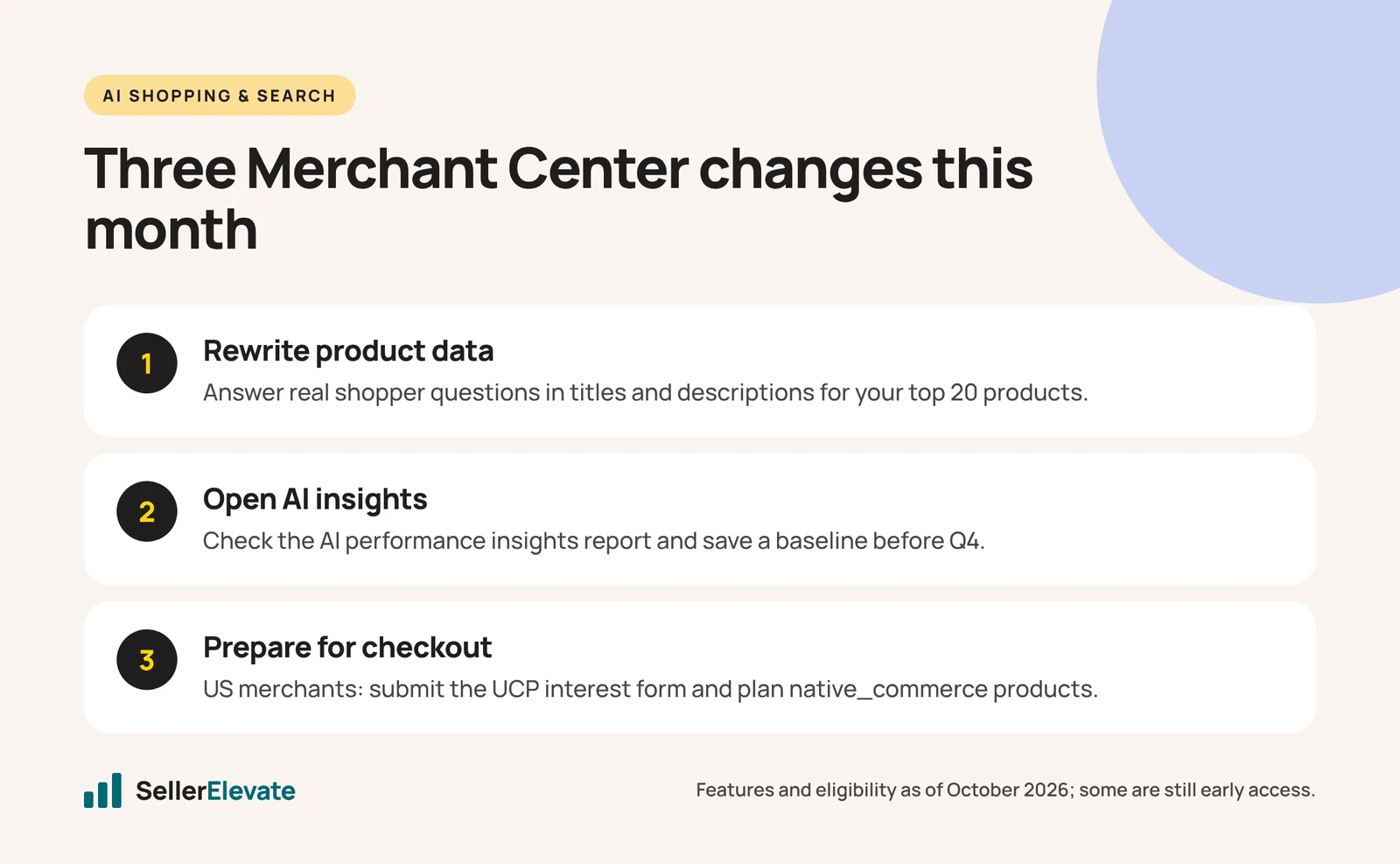
The three Merchant Center changes to make this month
1. Rewrite product data for conversation, not keywords
At Marketing Live, Google announced “conversational attributes” for product descriptions in Merchant Center. Whatever form that tool takes in your account, the idea is the same: AI Mode matches products to long, specific questions.
Work through your top 20 products and make sure the feed answers the questions people actually ask:
- Who is it for, and what problem does it solve?
- What are the dimensions, materials and compatibility?
- What is in the box?
- How does it differ from the obvious alternative?
- Are price, availability and shipping times correct today?
Product titles should still lead with the product type and the most searched attribute. Descriptions should be full sentences, not a list of keywords. If your Amazon listing already does this well, reuse that work. This is the same discipline we apply in listing optimization.
2. Open the AI performance insights report
Google added an “AI performance insights” tool to Merchant Center that compares your visibility against competitors. At launch it was rolling out in the US, Canada, Australia, India and New Zealand. Check whether it is in your account. If it is, take a baseline now, before Q4 traffic distorts everything. Google also launched Ask Advisor, an AI assistant in Merchant Center that connects to Google Ads and Analytics. It can be a quick way to find feed errors, but check its suggestions before you apply them.
3. Prepare for checkout and offers
If you are a US merchant, decide whether to apply for UCP checkout. If yes, submit the interest form, confirm your payment provider supports Google Pay tokens, and plan which products get the native_commerce attribute. Start with products that have simple variants, stable stock and low return rates.
While you are there, review your Merchant Center promotions. Direct Offers lets Google show retailer discounts inside AI Mode, and clean promotion data puts you in a better position as that pilot widens.
How does this compare with ChatGPT?
Many brands are now asking whether to prioritize Google AI Mode or ChatGPT. Here is how they compare as of October 2026.
| Google AI Mode | ChatGPT | |
|---|---|---|
| Organic product listings | From Merchant Center feed | From a connected feed (required since September 2026) |
| Paid placements | Shopping ads from existing Shopping and PMax campaigns | Separate ChatGPT Ads Manager, beta |
| In-chat checkout | UCP checkout, US, selected merchants | Wound down in March 2026; purchases happen on your site |
| Measurement | Inside your existing Google Ads setup | New pixel and Conversions API |
For most of the brands we work with, Google is the easier first step, because the feed, the campaigns and the tracking already exist. ChatGPT needs new plumbing. See how to get your products recommended by ChatGPT and ChatGPT ads for ecommerce brands for that side.
What we'd do this week
- Export your Merchant Center feed and fix every disapproval and warning on your top 20 products.
- Rewrite those 20 descriptions in plain, specific sentences.
- Check your Shopping and Performance Max campaigns for target ROAS or CPA settings so tight that impression share has dropped.
- Open AI performance insights, if available, and save a screenshot as your baseline.
- If you are US-based, submit the UCP checkout interest form, and treat acceptance as a bonus, not a plan.
If your Google Shopping account needs a proper look before Q4, our Google Ads management team can start with a review of your feed and campaigns.
Frequently asked questions
Do I need a new campaign to show Shopping ads in AI Mode?
No. An August 2026 analysis from Common Thread Collective says Shopping ads in AI Mode are served through existing Shopping and Performance Max campaigns connected to Merchant Center, with no separate opt-in. Check that tight target ROAS or target CPA settings are not limiting impressions, and that your feed is complete.
Is UCP checkout available outside the US?
Not yet as of October 2026. Google's help page described UCP checkout as US-only for selected merchants. At Google Marketing Live in May 2026, Google said its agentic checkout would reach Canada and Australia in the coming months and the UK later. Check Merchant Center for current availability in your country.
Who handles returns on orders placed through AI Mode checkout?
You do. Under UCP checkout, merchants keep seller of record status, so returns, customer service and the customer relationship stay with the merchant. Shoppers pay through Google Pay. Your payment service provider needs to support Google Pay tokens, but you do not need a Google Pay button on your own site.
How big is Google AI Mode?
PPC Land reported more than 75 million daily active users when Shopping ads launched in February 2026, with queries two to three times longer than in classic search. Longer queries carry more detail about what shoppers want, which is why complete, specific product data matters more in AI Mode than keyword bids.
Sources
- Google: Shopping updates from Google Marketing Live (May 20, 2026)
- PPC Land: Google unveils Shopping ads in AI Mode (February 14, 2026)
- eMarketer: Google brings checkout to AI Mode (January 12, 2026)
- PPC Land: Google’s UCP checkout help page is finally here (March 2, 2026)
- PPC Land: Google brings UCP checkout out of AI Mode into main search results (May 10, 2026)
- Common Thread Collective: Google AI Mode now shows Shopping ads inline (August 31, 2026)
- TechWyse: AI shopping adoption vs consumer distrust (April 2026)
Get the honest version of your numbers
A free account audit from the person who would actually run your account.