Should I use Pan-European FBA or EFN?
Use EFN while testing Europe: one storage country and one VAT registration, but cross-border fees of about €1.50 to €3.00 or more per unit. Move proven SKUs to Pan-European FBA once volume is steady, accepting VAT obligations in each country that holds stock in return for lower fees and faster delivery.
Key takeaways
- EFN needs one VAT registration but adds a cross-border fee of roughly €1.50 to €3.00 or more per unit.
- Pan-EU stores stock in up to seven countries and creates VAT obligations in each.
- EPR registration applies wherever you sell, under either model.
- Flex Fulfillment says EFN adds two to three days to delivery, which can cost conversions.
- Many sellers mix the two: Pan-EU for bestsellers, EFN for slower SKUs.
Use EFN (the European Fulfillment Network) while you are testing Europe, and move your proven sellers to Pan-European FBA once volume justifies the extra VAT registrations. EFN means one warehouse country and one VAT registration but higher per-order fees and slower delivery; Pan-EU means lower fees and faster Prime delivery but a VAT and compliance obligation in every country that holds your stock.
That is the short version. The right answer depends on your monthly EU volume, how many SKUs you have, and how much compliance overhead you can carry. Here is how we decide.
How do Pan-EU and EFN actually differ?
With EFN, you send inventory to fulfillment centers in one EU country, usually Germany. When a shopper in France, Italy or Spain orders, Amazon ships it cross-border from that country and charges you a cross-border fulfillment fee on top of the local fee.
With Pan-European FBA, you still send inventory into one country, but Amazon distributes it across fulfillment centers in several EU countries based on expected demand. Orders ship locally. Amazon’s Europe selling page says Pan-EU lets you “distribute your units across multiple EU countries at no additional cost to you.”
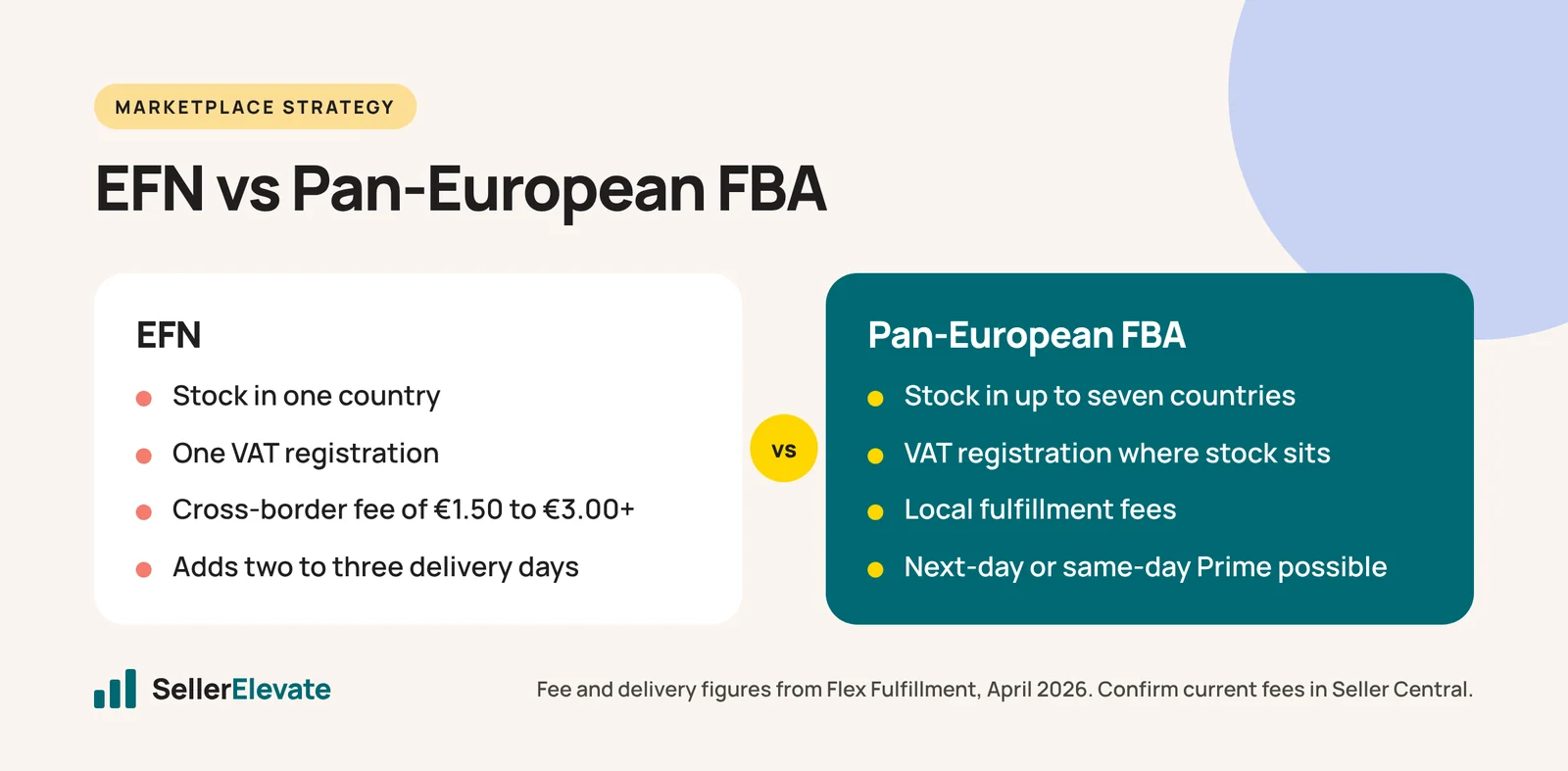
| EFN | Pan-European FBA | |
|---|---|---|
| Where stock sits | One country | Up to seven countries |
| VAT registrations | One (storage country) | One per country holding stock |
| Fulfillment fees | Local fee plus €1.50 to €3.00+ cross-border (Flex Fulfillment estimate) | Local fees |
| Delivery speed | Slower outside the storage country | Local, Prime-speed |
| Compliance overhead | Low | High |
| Best for | Testing, low volume, slow SKUs | Proven sellers at volume |
The sources we checked disagree slightly on the country list. Flex Fulfillment (April 2026) lists seven: Germany, France, Italy, Spain, Poland, Czech Republic and Sweden. Nova Data (July 2026) describes six to seven, typically Germany, France, Italy, Spain, Poland and the Czech Republic. Check the current list in Seller Central before you plan registrations, because the list decides your VAT bill.
How much more does EFN cost?
As of October 2026, Flex Fulfillment puts the EFN cross-border premium at €1.50 to €3.00 or more per unit compared with local fulfillment. Nova Data frames it the other way: Pan-EU fees run 20% to 40% below EFN cross-border fees per unit. These are third-party estimates, not Amazon’s fee card, so pull the current EFN rate for your size tier from Seller Central before you model it.
A worked example with hypothetical numbers: you sell 400 units a month outside your storage country at a €2.00 cross-border premium. That is €800 a month, or €9,600 a year, in EFN fees you would not pay under Pan-EU. Now compare it with the cost of extra VAT registrations and filings. If an accountant or VAT service charges you in the low thousands per country per year (get real quotes; this varies a lot), five extra countries can cost more than the €9,600 you save. At 1,500 units a month, the answer flips.
That is the whole decision in miniature: cross-border fees scale with volume, compliance costs are mostly fixed.
What are the VAT and EPR obligations for each?
EFN: you register for VAT in the storage country. Flex Fulfillment notes that the One Stop Shop (OSS) scheme can then cover cross-border sales to consumers in other EU countries through a single return.
Pan-EU: storing goods in a country generally creates a VAT registration and filing obligation there. Flex Fulfillment says this can mean up to seven separate VAT registrations and filings. OSS does not remove the need to register where you hold stock.
EPR applies under both. Nova Data stresses that Extended Producer Responsibility registration (for packaging and, in some categories, electronics, batteries or textiles) is required per country you sell into, whichever fulfillment model you choose. Choosing EFN to avoid EPR does not work.
Amazon’s own guidance is blunt: “if you store or sell goods to customers in an EU country, you may be required to register for VAT in that country,” and it suggests starting registration as soon as you open a Europe account, because it takes time.
Does Pan-EU help ranking and conversion?
Indirectly, yes. Flex Fulfillment says EFN adds two to three days to delivery compared with local fulfillment, and that Pan-EU enables next-day or same-day Prime delivery through local stock. A slower delivery promise shows up on the detail page, and shoppers compare delivery dates. Faster delivery tends to lift conversion, and conversion feeds ranking. We wrote about this effect in the US context in delivery speed is now a ranking lever; the logic carries over.
So the real comparison is not only fees against VAT costs. In countries where you compete on Prime speed, EFN can cost you sales you never see in a fee report.
Which should you choose at each stage?
Our decision rules, as of October 2026:
- Just testing Europe, or under a few hundred EU orders a month: EFN from Germany. One VAT registration, EPR where you sell, and learn which countries actually buy.
- One or two countries clearly working: consider storing stock locally in those countries (via Pan-EU’s country selection or separate inbound) and keep EFN for the rest.
- Steady volume across the major markets: Nova Data suggests Pan-EU becomes cost-effective above roughly 500 units a month across the EU5. Use that as a prompt to run your own numbers, not as a hard line.
- Large catalog with a long tail: mix them. Nova Data suggests Pan-EU for bestsellers and EFN for slower SKUs, which matches what we would do. Pan-EU enrollment is set at the SKU level, so you do not have to move everything at once.
A note for UK-based sellers: since Brexit, the UK and EU run separate fulfillment networks. Flex Fulfillment explains that UK sellers are treated as non-EU importers and need an EU EORI number, delivered-duty-paid shipping and customs representation. If you are a US brand deciding between the UK and the EU first, read our companion piece on selling on Amazon UK from the US.
Which mistakes cost sellers the most?
- Enrolling in Pan-EU before VAT numbers are live. Amazon moves stock into countries where you are not yet registered, and you are storing goods there without a VAT number. Register first, enroll second.
- Treating EFN as a way around EPR. It is not. Register for EPR wherever you sell.
- Moving the whole catalog at once. Slow SKUs spread across seven countries mean thin stock everywhere and more long-term storage exposure.
- Comparing fees only. Leave out the conversion effect of slower delivery and EFN looks cheaper than it is.
- Never revisiting the choice. A SKU that was slow last year may be a bestseller now. Review the split each quarter.
What we'd do this week
- Pull your last 90 days of EU orders by country and SKU, or estimate them if you have not launched.
- Get the current EFN cross-border fee for your size tiers from Seller Central.
- Get written quotes for VAT registration and filing in each Pan-EU country, plus EPR in each country you sell into.
- Calculate annual EFN premium against annual extra compliance cost, per SKU.
- Enroll only the SKUs where Pan-EU clearly wins, and review the split every quarter.
If you want help modelling the split or running the EU accounts day to day, that is part of our account management work. The same thinking applies to North America, where Remote Fulfillment to Canada and Mexico plays the role EFN plays in Europe.
Frequently asked questions
Can I use OSS instead of registering for VAT in each Pan-EU country?
No. The One Stop Shop scheme simplifies reporting of cross-border sales to consumers, but storing goods in a country generally still requires a VAT registration there. OSS fits EFN well; it does not remove registrations under Pan-EU. Confirm your case with an EU VAT adviser.
Can UK sellers use EFN to reach the EU?
Not as before Brexit. The UK and EU now run separate fulfillment networks, and UK sellers are treated as non-EU importers. Flex Fulfillment notes they need an EU EORI number, delivered-duty-paid shipping and customs representation to place stock in the EU.
Can I choose which SKUs go into Pan-EU?
Yes. Pan-EU enrollment is set at the SKU level, so you can enroll bestsellers and keep slower SKUs on EFN. This mixed approach limits thin stock spread across many countries while still getting local delivery for the products that sell most.
Which country should I use as my EFN base?
Most sellers choose Germany, the largest Amazon market in the EU, so most orders ship locally and only the rest pay cross-border fees. If your sales skew heavily to another country, base your stock where the majority of orders come from.
Sources
- Nova Data: Pan-EU vs EFN (July 2026)
- Flex Fulfillment: Pan-EU vs EFN for UK sellers 2026 (April 2026)
- Amazon: Sell in Europe (accessed October 2026)
Get the honest version of your numbers
A free account audit from the person who would actually run your account.