What is a good ROAS for my store?
Any ROAS above your break-even ROAS, which is 1 divided by your contribution margin before ad spend. If you keep 40% of the price after product cost, fees, shipping and returns, you break even at 2.5. Benchmarks ignore your margin, so calculate your own number per SKU.
Key takeaways
- Break-even ROAS equals 1 divided by contribution margin before ad spend.
- Target ROAS equals 1 divided by contribution margin minus your target profit percentage.
- In our hypothetical $40 example, break-even ROAS is 2.58 on Amazon and 2.34 on Shopify.
- On Amazon, break-even ACoS equals your contribution margin before ads.
- If platform ROAS looks healthy but MER is below blended break-even, attribution is flattering you.
A good ROAS for your store is any ROAS above your break-even ROAS, and your break-even ROAS is 1 divided by your contribution margin before ad spend. A product that keeps 40% of its price after product cost, fees, shipping and returns breaks even at a 2.5 ROAS; one that keeps 25% needs 4.0 just to stand still.
That is why industry benchmarks are close to useless on their own. A 3.0 ROAS is excellent for one brand and a slow bleed for another. Here is how to calculate your own number, the target above it, and how the maths differs between Amazon and Shopify.
Why don't ROAS benchmarks tell you if you're profitable?
Benchmarks describe what other advertisers get, not what you need. Eightx, a DTC growth firm, publishes 2026 median platform ROAS figures of 2.5x for Meta and 4.2x for Google Shopping. If your break-even is 2.3, a 2.5 Meta ROAS is profitable. If your break-even is 3.5, the median is losing money on every order.
Two more problems with benchmarks:
- Platform ROAS is attributed, not proven. Eightx’s own warning: platform-reported ROAS “is systemically inflated after iOS 14 and tells you only what a channel claims.” You can be above break-even in Ads Manager and below it in your bank account.
- Margins vary more than ROAS does. Two brands at the same ROAS can have very different profit because one has a 70% gross margin and the other has 35%.
So start from your own unit economics.
How do you calculate break-even ROAS?
Three steps.
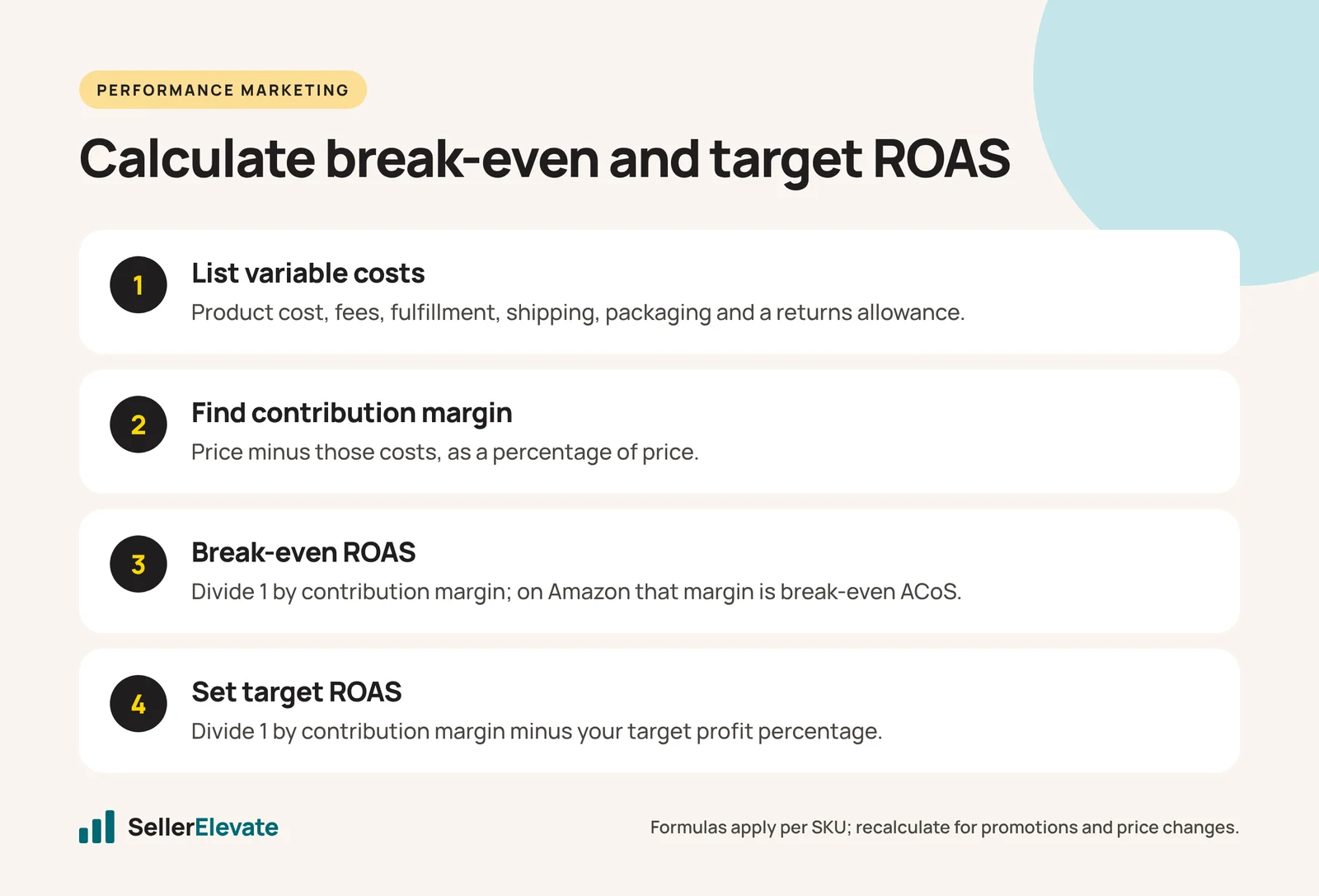
- List every variable cost per order except advertising. Landed product cost (including freight and duty), marketplace or payment fees, fulfillment and shipping, packaging, and an allowance for returns and refunds.
- Calculate contribution margin before ads. Price minus those costs, as a percentage of price.
- Divide 1 by that percentage. That is break-even ROAS. Its inverse is break-even ACoS on Amazon.
Then set a target ROAS that leaves profit:
Target ROAS = 1 / (contribution margin % − target profit %)
If you keep 40% before ads and want 15% left after ads, you can spend 25% of revenue on ads, so target ROAS is 1 / 0.25 = 4.0.
Eightx frames the same idea using contribution margin tiers: their example has CM2 (after product, shipping and processing) of 43%, a CM3 target of 25%, leaving 18% of revenue for marketing, which gives a break-even ROAS of 1 / 0.18 = 5.6x. Same formula, stricter profit target.
Amazon vs Shopify: a worked example
Hypothetical numbers for one $40 product, sold both ways. Replace every line with your own.
| Cost per order | Amazon (FBA) | Shopify (own site) |
|---|---|---|
| Price | $40.00 | $40.00 |
| Landed product cost | $10.00 | $10.00 |
| Referral fee (15%) | $6.00 | n/a |
| Payment processing (2.9% + 30¢) | n/a | $1.46 |
| Fulfillment and shipping (assumed) | $6.50 FBA fee | $7.00 shipping + $2.50 pick/pack |
| Packaging (assumed) | included | $0.75 |
| Storage and other fees (assumed) | $0.80 | n/a |
| Returns allowance (3%, assumed) | $1.20 | $1.20 |
| Contribution before ads | $15.50 (38.75%) | $17.09 (42.7%) |
| Break-even ROAS | 2.58 | 2.34 |
| Target ROAS at 15% profit | 4.21 | 3.61 |
Where the fee numbers come from: Amazon’s pricing page lists a 15% referral fee for Home and Kitchen (with a $0.30 minimum), with categories ranging from 5% to 45% and most between 8 and 15%. Shopify’s pricing page lists 2.9% + 30¢ for US online standard cards on the Basic plan, lower on higher plans. The FBA fee, shipping, pick/pack and storage figures above are assumptions; check your own FBA fee preview and shipping invoices, because these lines move break-even more than anything else.
On Amazon, break-even ACoS is simply the contribution margin: 38.75% in this example. A campaign at 30% ACoS is profitable on those orders; one at 45% is not.
Two things the table does not capture:
- Shopify customers can be emailed again. If a meaningful share reorder, you can accept a lower first-order ROAS, as long as you know your repeat rate rather than hoping for it.
- Amazon ad sales can lift organic rank. Some of the value of a Sponsored Products order shows up later as organic sales. That is why we track TACoS (ad spend divided by total sales) alongside ACoS. On one SKU we managed, $358K of ad spend ran at a 4.00 ROAS with TACoS under 10%, which is only meaningful because the margin supported it.
Should you use ROAS, MER or TACoS?
Each answers a different question, and we use all three.
| Metric | Formula | Use it for | Weakness |
|---|---|---|---|
| ROAS | Attributed revenue / ad spend | Campaign and creative decisions inside one platform | Platform attribution over-credits |
| MER | Total revenue / total marketing spend | Is the whole business making money from marketing | Does not say which channel to cut |
| TACoS (Amazon) | Ad spend / total Amazon sales | Is advertising building or renting your sales | Moves slowly, needs weeks to read |
Eightx’s summary is a sensible one: ROAS for channel tactics, MER for budget allocation, blended CAC for planning. Apply the same break-even logic to MER: if your blended contribution margin is 40%, MER below 2.5 means marketing as a whole is losing money, whatever each platform claims.
What mistakes make the ROAS target wrong?
- Using gross margin instead of contribution margin. Gross margin often ignores fees, shipping and returns. On Amazon that can overstate your margin badly: in the example above, the referral fee, FBA fee and storage alone take $13.30 of a $40 sale.
- Forgetting returns. Apparel and electronics return rates can wipe out the whole profit margin. Use your actual refund rate.
- Ignoring discounts. A 20% off promotion during a sale changes contribution margin, so break-even ROAS for that week is higher. Recalculate for promotional periods.
- One target for all products. A bundle at 55% margin and a single unit at 30% need different targets. Set them by SKU or by margin band.
- Treating break-even as the goal. Break-even ROAS is the floor for growth spend such as launches, not a long-term target. Above it, decide how much profit you want to keep.
What we'd do this week
- Build the cost table above for your top five SKUs, using real invoices and the FBA fee preview or your carrier bills.
- Write break-even and target ROAS next to each SKU, and break-even ACoS for Amazon.
- Compare those targets with the last 30 days of ROAS by campaign. Flag anything below break-even that is not deliberately a launch or ranking campaign.
- Calculate MER for the last three months. If platform ROAS looks healthy but MER is below your blended break-even, attribution is flattering you.
- Raise bids only where ROAS sits well above target, and only after the listing converts. Our Amazon PPC team sets bid rules from exactly these numbers.
If the targets you calculate look impossible to hit, the problem is usually price or product cost, not advertising. That is a pricing and positioning conversation, and it is worth having before you raise spend.
Frequently asked questions
What is the difference between break-even ROAS and target ROAS?
Break-even ROAS is where ad spend uses up all contribution margin, leaving zero profit. Target ROAS leaves the profit you want: 1 divided by contribution margin minus target profit. With 40% margin and a 15% profit goal, you can spend 25% of revenue, so target ROAS is 4.0.
How do I convert break-even ROAS to break-even ACoS?
ACoS is the inverse of ROAS, so break-even ACoS equals your contribution margin before ads. In our hypothetical Amazon example, contribution is 38.75%, so campaigns below 38.75% ACoS make money on those orders and campaigns above it lose money. Check this per SKU, since margins differ.
Should I use gross margin to calculate ROAS targets?
No. Gross margin often leaves out marketplace fees, payment processing, fulfillment, shipping and returns. Use contribution margin, which subtracts every variable cost per order except advertising. On Amazon, referral and FBA fees alone can take a large share of the price.
Do ROAS targets change during sales events?
Yes. A discount lowers contribution margin, which raises break-even ROAS for that period. Recalculate before promotions such as Prime Big Deal Days or Black Friday, and expect lower profit per order even if ROAS looks similar to normal weeks. Set promotional targets per SKU.
Sources
- Eightx: ROAS vs MER vs blended CAC, which metric actually matters in 2026 (updated 24 June 2026)
- Amazon: Selling on Amazon fees and pricing (accessed October 2026)
- Shopify: Pricing (accessed October 2026)
Get the honest version of your numbers
A free account audit from the person who would actually run your account.