How big is social commerce in 2026?
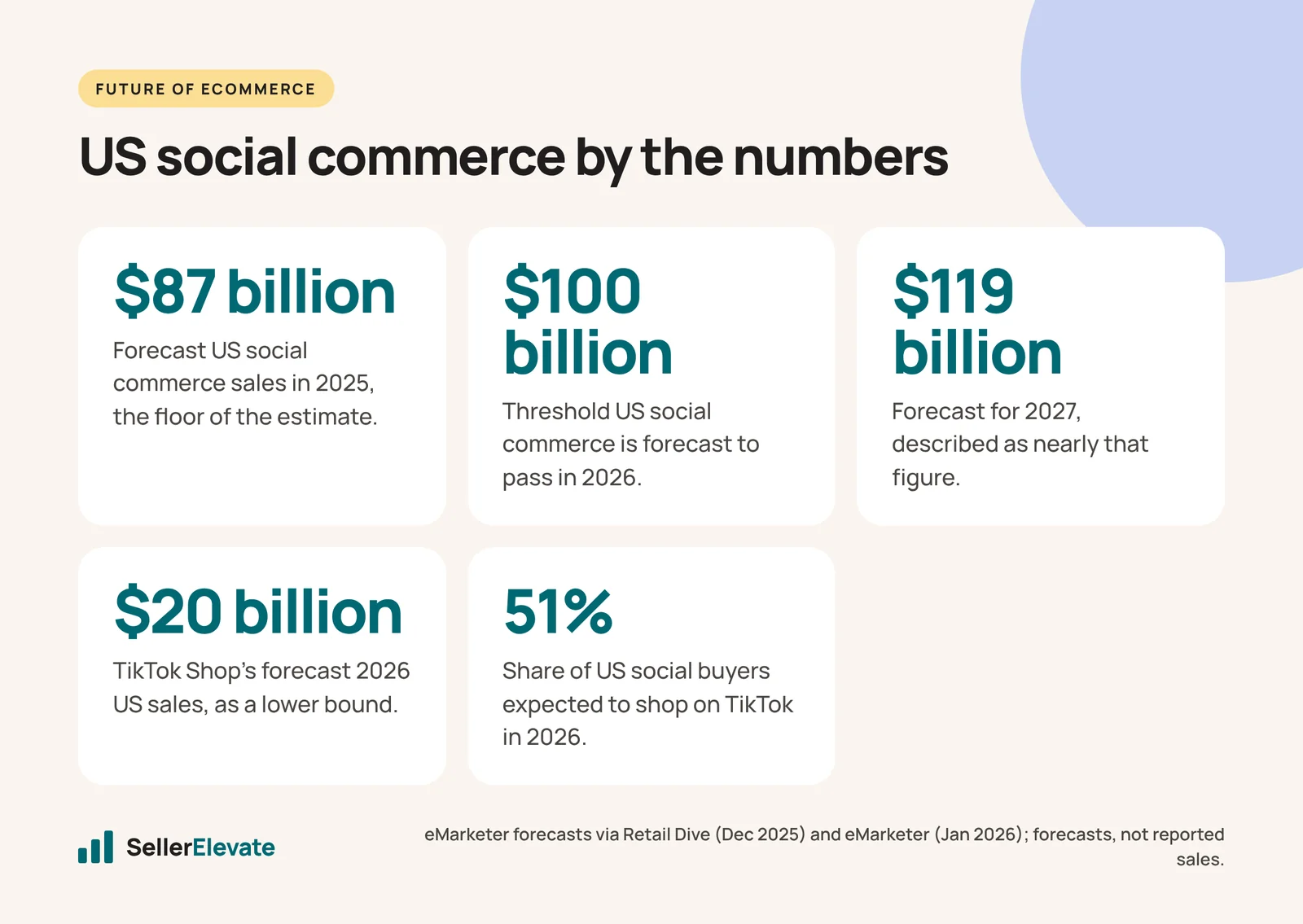
eMarketer forecasts US social commerce will pass $100 billion in 2026, up from more than $87 billion in 2025 and reaching nearly $119 billion in 2027. TikTok Shop is forecast above $20 billion in 2026, while Facebook Marketplace and Instagram still account for most of the remaining sales.
Key takeaways
- eMarketer forecasts US social commerce will exceed $100 billion in 2026 and reach nearly $119 billion in 2027.
- TikTok Shop is forecast to pass $20 billion in 2026 and approach 25% of social commerce by 2027.
- 51% of US social buyers are expected to shop on TikTok in 2026.
- Facebook Marketplace and Instagram still hold most social commerce sales, so abandoning Meta for TikTok is a mistake.
- Creator commerce is concentrated: in one client account, the top four videos drove about 57% of video revenue.
US social commerce is forecast to pass $100 billion in sales in 2026, according to eMarketer, up from more than $87 billion in 2025. TikTok Shop is the fastest-growing part of it, but Facebook Marketplace and Instagram still account for most of the money, which matters when you decide where to spend.
The headline number is real. What it means for your brand depends on your category, your margins and whether you can produce video at volume. This post separates the growth that is real from the hype and gives you rules for deciding how much to invest.
How big is social commerce in 2026?
Here are eMarketer’s forecasts as reported by Retail Dive in December 2025:
| Year | US social commerce sales | TikTok Shop |
|---|---|---|
| 2025 | More than $87 billion | Nearly 20% of social commerce |
| 2026 | More than $100 billion | More than $20 billion |
| 2027 | Nearly $119 billion | Nearly 25% of social commerce |
| 2028 | Not stated | More than $30 billion |
Two other data points from eMarketer:
- More than half (51%) of US social buyers will shop on TikTok in 2026, per its 2026 social commerce forecast.
- By 2028, more than half of US online shoppers are expected to have bought something through social media.
eMarketer’s own summary is measured: “Growth is accelerating, but it’s uneven, favoring platforms and strategies that turn attention into action.” Its analyst Rachel Wolff told Retail Dive that “TikTok’s ability to blend shopping and entertainment is turning the platform into an e-commerce powerhouse.”
These are forecasts, not reported sales, and the full eMarketer report is behind a paywall. Treat the exact figures as directional.
Where is the growth real, and where is it hype?
Read the table again. If TikTok Shop is around $20 billion of a $100 billion market, most social commerce spending still happens elsewhere, mostly Facebook Marketplace and Instagram according to Retail Dive’s summary. Three conclusions follow.
Real: TikTok Shop is taking share fast. Going from nearly 20% of the market to nearly 25% in two years, inside a market that is itself growing, is genuine momentum. The 51% figure means half of social shoppers are already buying there.
Real: Facebook and Instagram still matter. Brands that pulled out of Meta to chase TikTok left the bigger pool behind. For many categories, especially older buyers and higher price points, Meta’s audience is still where purchases happen.
Hype: “social commerce will replace Amazon.” A market just over $100 billion is substantial but still a minority of US ecommerce, and a lot of social discovery ends in a search on Amazon. We see the same pattern in our own accounts: TikTok creates demand that often converts elsewhere. Our post on measuring TikTok’s halo on Amazon sales shows how to track it.
Which brands should prioritize social commerce?
Use these rules to decide how much effort to put in.
- Prioritize it if your product demonstrates well on camera in under 30 seconds, sells at a price people buy on impulse (our rule of thumb is roughly under $50), has margin left after a creator commission plus platform fees, and appeals to younger buyers. Beauty, personal care, kitchen gadgets, fashion accessories and supplements (within the rules) fit.
- Test it if your product needs explanation but has a visible result, or your price is higher but your audience is active on social. Start with Facebook and Instagram if your buyers skew older.
- Deprioritize it if your margins cannot absorb commission plus fees plus samples, your product is a considered purchase that people research for weeks, or you cannot produce or source video consistently.
A worked example, with hypothetical numbers. Take a $30 serum with a 70% gross margin, so $21 of gross profit per unit before selling costs. Suppose platform fees take about $2.40, the affiliate creator earns $4.50, shipping and packaging cost $4.00, and samples plus paid boosts average $5.00 per order across the month. That leaves roughly $5.10 of contribution per order. Positive, but thin: a few returns, a promotion stacked on top, or a slower month for the creator videos can push it below zero.
Now run the same exercise for a $12 item with a 50% margin, so $6 of gross profit. The commission, fees and shipping alone can wipe that out before any sample cost. That is why low-price items on social often only work as bundles, or as an entry product that leads customers to a second purchase on a channel you control.
Plug your own fee and commission rates into this structure. If contribution per order is not clearly positive at realistic volumes, the size of the market does not help you.
Before any of this, check your real cost. TikTok Shop’s fees, commissions, sample costs and ad spend add up to more than the referral fee on the rate card. We break it down in TikTok Shop’s real take rate.
What does winning on social commerce actually take?
Volume, and concentration. Our own data shows both. One brand we work with ran 2,449 TikTok affiliates, and the top four videos drove about 57% of video revenue. That is how creator commerce usually behaves: hundreds of creators produce a handful of videos that matter, and you cannot predict in advance which ones.
The operational implications:
- You need many shots on goal. A brand working with ten creators is unlikely to find its breakout video. You need a pipeline of samples and outreach that runs every week.
- You need to spot winners fast. When a video takes off, boost it with paid spend and get more creators to make similar content while the format is working.
- You need inventory and fulfillment ready. A video that spikes sales for three days can sink your shop health metrics if you cannot ship on time.
- You need to own the customer afterwards. Social platforms keep most of the customer relationship. Push buyers toward reviews, your email list where allowed, and repeat purchase on whichever channel you control best.
What about live shopping?
Live selling is the part of social commerce most brands find hardest. It works best for products that benefit from demonstration and for sellers who can show up on schedule. If you are curious about TikTok live, read our guide to running your first TikTok Shop live. For enthusiast categories, Whatnot has become a serious alternative; we covered it in whether your brand should sell on Whatnot.
What we'd do this week
- Pull your channel numbers. How much revenue comes from social today, by platform, and what is the contribution margin after fees, commission and ads?
- Score your product against the rules above. Be honest about video and margin.
- If you are already on TikTok Shop, sort affiliate videos by revenue. If a few dominate, put creator recruitment behind more of that format.
- If you are not on TikTok Shop, decide whether to launch based on margin, not momentum. Our post on whether Amazon brands should launch TikTok Shop walks through it.
- Do not abandon Meta to fund TikTok. Rebalance budgets based on margin per order, not on which platform is growing faster.
If you want help setting up or scaling a shop, our TikTok Shop management team runs creator programs and shop operations day to day.
Frequently asked questions
Is social commerce bigger than Amazon?
No. A market just over $100 billion is substantial but remains a minority of US ecommerce, and Amazon alone sells far more. Social platforms are strongest at discovery, and many shoppers who find a product on social still buy it through search on Amazon or a brand site.
What share of social commerce does TikTok Shop have?
eMarketer, as reported by Retail Dive, put TikTok Shop at nearly 20% of US social commerce in 2025, forecast to approach 25% in 2027. Its 2026 sales are forecast above $20 billion, with more than $30 billion expected by 2028.
Should I move my Meta ad budget to TikTok Shop?
Not wholesale. Facebook and Instagram still account for most social commerce spending, and they often reach older, higher-spending buyers. Rebalance based on contribution margin per order on each platform rather than growth headlines, and keep testing both.
How many creators does a brand need on TikTok Shop?
Usually far more than brands expect, because results concentrate in a few videos. One SellerElevate client worked with 2,449 affiliates, and the top four videos drove about 57% of video revenue. Plan for a steady weekly pipeline of samples and outreach.
Sources
- Retail Dive: TikTok Shop drives social commerce growth (December 18, 2025), citing eMarketer forecasts
- eMarketer: US Social Commerce Forecast 2026 (January 7, 2026)
Get the honest version of your numbers
A free account audit from the person who would actually run your account.