How do I check if ChatGPT recommends my brand?
Ask ChatGPT the questions your customers ask, in a fresh chat, and run each prompt twice because answers vary. Use 12 prompts across category, problem, comparison and brand questions, then score whether you appear, where, how accurately and which sources it cites. That manual audit takes about 30 minutes.
Key takeaways
- AEO and GEO both mean getting your products named in AI-generated answers, and for a product brand the difference in names matters little.
- Yotpo cites research finding only about 11% domain overlap between traditional search results and AI citations.
- A 30-minute manual audit with 12 prompts across five assistants shows where you stand before you buy any tool.
- AI answers vary, so run each prompt at least twice in a fresh chat and track the same prompts monthly.
- Amazon sellers should include Alexa for Shopping in the audit, because it answers from the listing, reviews and Q&A.
To check whether ChatGPT recommends your brand, ask it the questions your customers ask, in a fresh chat, several times, and record whether you appear, where, and what it says. You can do a useful version of this by hand in about 30 minutes before you pay for any AI visibility tool, and the manual audit will tell you whether a tool is worth buying.
This post explains what AEO and GEO mean for a product brand, gives you the prompts we use, and covers when a paid tracker makes sense.
What are AEO and GEO for ecommerce?
They are two names for roughly the same job: getting your products named in AI-generated answers.
- AEO (answer engine optimization) is the term Yotpo uses for structuring your data so large language models cite your brand. Its point is that traditional SEO matches keywords in a fairly predictable way, while AI answers come from probabilistic models.
- GEO (generative engine optimization) is how ShopVision describes optimizing your site, product data and off-site presence so AI shopping assistants surface your products in their recommendations.
For a product brand, the difference does not matter much. What matters is that being on page one of Google no longer means you show up in AI answers. Yotpo cites research finding only about 11% domain overlap between traditional search results and AI citations. The sites AI trusts are often not the ones ranking in Google.
Why care now? Adobe data reported in April 2026 showed AI traffic to US retail sites up 393% year over year in Q1 2026, and in March 2026 that traffic converted 42% better than non-AI traffic. We look at whether that holds up in does AI traffic convert.
Which AI assistants should a product brand track?
Track where your buyers actually ask. For most of our clients that means:
| Assistant | Why it matters | Note for Amazon sellers |
|---|---|---|
| ChatGPT | The largest general assistant, now with shopping research and ads | It cannot read Amazon’s live pages (why) |
| Google AI Mode and AI Overviews | Sits on top of the search engine most shoppers still use | Check it alongside your Google Shopping presence |
| Perplexity | Smaller, but cites sources clearly, which makes it easy to audit | Its Comet agent is in litigation with Amazon |
| Gemini | Matters if your buyers live in Google’s ecosystem | Similar sources to Google AI Mode |
| Alexa for Shopping (on Amazon) | The assistant inside Amazon, formerly Rufus | For Amazon sellers this is often the one that matters most |
If you sell mainly on Amazon, do not skip the last row. Alexa for Shopping answers from your listing, reviews and Q&A. We cover it in optimizing your listing for Alexa for Shopping.
How do I check if ChatGPT recommends my brand? The 30-minute audit
You need a spreadsheet, a logged-out or private browser window, and the five assistants above. Here is the process we run.
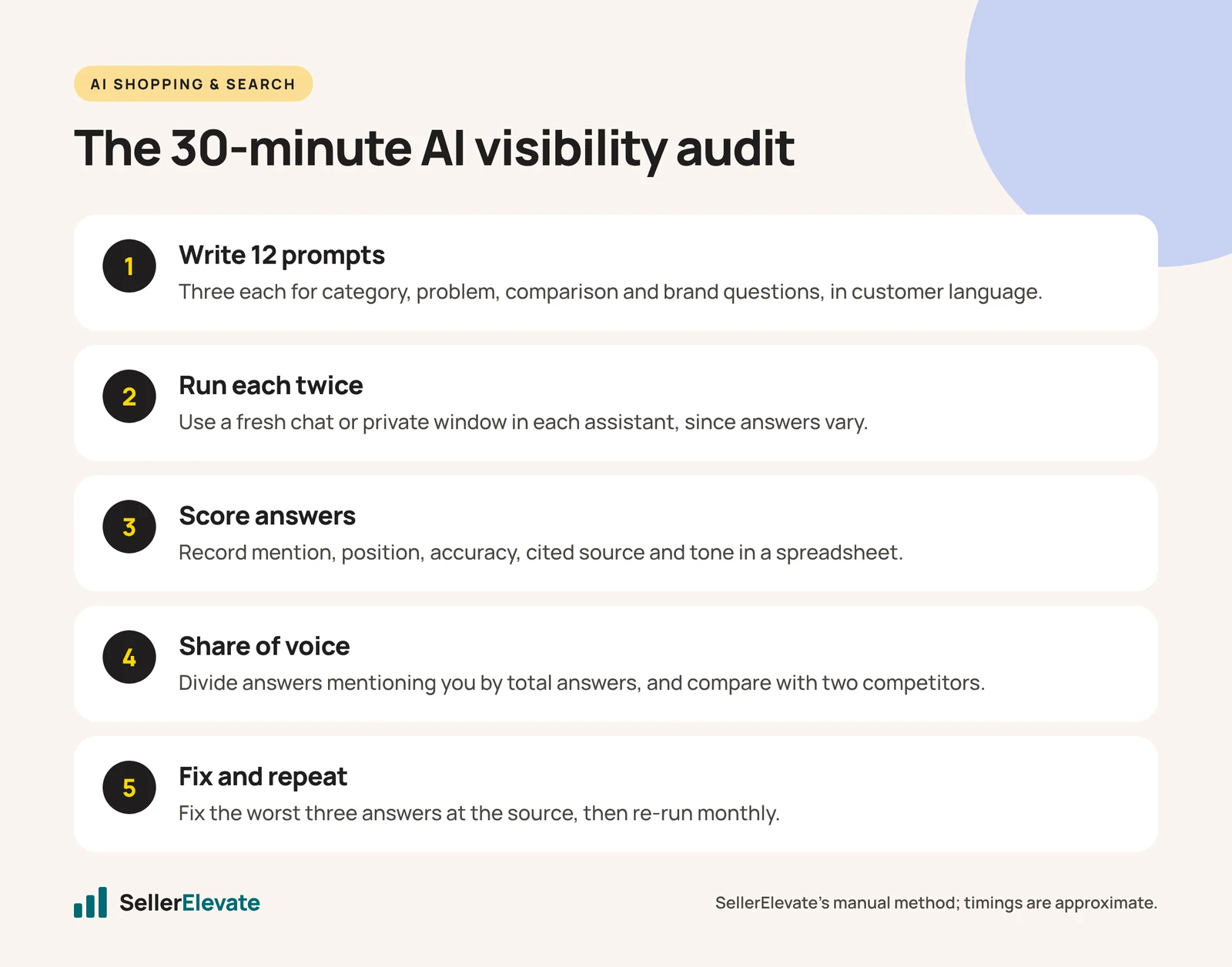
Step 1: Write 12 prompts in four groups (5 minutes). Use your customers’ words, not your marketing copy.
- Category (3 prompts): “What is the best [product] for [use]?” “What [product] should I buy under $[price]?” “Which [product] brands are worth it?”
- Problem (3 prompts): “How do I fix [problem your product solves]?” “What helps with [problem] for [type of person]?” “What do people use for [job]?”
- Comparison (3 prompts): “[Your brand] vs [top competitor].” “Is [competitor] better than [your brand]?” “Alternatives to [competitor].”
- Brand (3 prompts): “Is [your brand] any good?” “What are the downsides of [your brand]?” “Where should I buy [your brand]?”
Step 2: Run each prompt in a fresh chat, twice (15 minutes). AI answers change with context and over time. Superlines makes the same point: the same query can produce different answers. Running each prompt twice in a clean session catches the obvious swings.
Step 3: Score each answer in your sheet (10 minutes). Use five columns:
- Mentioned? Yes or no.
- Position. First, in the list, or last.
- Accurate? Are the price, features and claims right?
- Source. Which sites did it cite or seem to draw on? Perplexity and Google show these, and ChatGPT sometimes does.
- Tone. Positive, neutral, or carrying a caveat (“some users report…”).
Step 4: Work out your share of voice. Count the answers that mention you and divide by the total. Do the same for your top two competitors. If you appear in 4 of 24 category and problem answers and your main competitor appears in 15, you know where you stand. (Those numbers are a hypothetical example.)
The brand prompts are often the most useful. If ChatGPT says your product is out of stock, lists an old price, or repeats a three-year-old complaint, you have found a fixable problem that no ranking report would show you.
What should I fix after the audit?
The audit tells you what is wrong. Here is what usually fixes it, roughly in order of effort.
- Make your site readable to AI crawlers. ShopVision recommends allowing GPTBot, OAI-SearchBot, Google-Extended, ClaudeBot and PerplexityBot in robots.txt. Check that your platform or a security app has not blocked them.
- Add complete Product schema. Name, image, description, brand and offers at minimum, in JSON-LD.
- Write titles in plain shopper language. “Waterproof men’s hiking boots” beats a clever product name on its own.
- Answer real questions on the page. Use the questions from your audit and your customer service inbox as FAQ content.
- Fix the sources AI is quoting. If an old review roundup is driving a negative answer, a newer, accurate source is the fix.
- Build reviews on more than one platform. An Amazon-only review base is invisible to assistants Amazon blocks.
When is a paid AEO tool worth it?
The category has grown fast. Yotpo’s roundup, updated May 17, 2026, lists 17 AEO tools, including Profound, Peec AI, Semrush’s AI Toolkit and Ahrefs Brand Radar. Superlines adds Otterly AI and Promptwatch among others. They automate what you just did by hand: hundreds of prompts, multiple assistants, tracked over time, with competitor share of voice.
They have a weakness to know about. Superlines cites a Surfer study finding that visibility data pulled through AI APIs often differs from answers scraped from the real ChatGPT and Perplexity interfaces. Ask any vendor which method it uses.
Our rule of thumb:
| Situation | Our advice |
|---|---|
| You have never checked | Run the manual audit first. It is free. |
| You appear rarely and the fixes are obvious | Fix first, re-run the manual audit in 60 days |
| You sell across several channels and AI is already a visible traffic source | A paid tracker earns its cost |
| You are being asked to report AI share of voice to a board or investors | Buy a tool, and document its method |
What we would do this week
- Run the 30-minute audit with the 12 prompts across the assistants that matter to you.
- Pick the three worst answers and trace where the bad information comes from.
- Fix your own site first: crawler access, Product schema, real FAQs.
- If you sell on Amazon, run the same brand prompts in Alexa for Shopping and compare. Our listing optimization work covers what feeds that assistant.
- Put a recurring reminder in the calendar and re-run the same prompts monthly so you can see change over time.
Related reading: how to get your products recommended by ChatGPT covers the content side in more depth, and if you also run a Shopify store, check whether Amazon’s own agent is listing your products in Amazon Buy for Me.
Frequently asked questions
What is the difference between AEO and GEO?
Very little in practice. AEO, answer engine optimization, is about structuring your data so AI models cite you. GEO, generative engine optimization, covers your site, product data and off-site presence so AI assistants recommend your products. Both aim to get your brand named in AI answers, and the same fixes serve both.
Which AEO tools track AI visibility for ecommerce?
Yotpo's roundup, updated May 17, 2026, lists 17 tools including Profound, Peec AI, Semrush's AI Toolkit and Ahrefs Brand Radar, and Superlines adds Otterly AI and Promptwatch. Ask each vendor whether it pulls answers through APIs or from real interfaces, since a Surfer study found the two can differ.
How often should I re-run an AI visibility audit?
Monthly is a sensible rhythm for most brands. AI answers change with model updates and new sources, so a single check is a snapshot. Use the same prompts each time so you can compare, and re-run sooner after you fix your site or after a competitor launch.
Should I block AI crawlers on my own website?
Not if you want AI to recommend you. ShopVision recommends allowing crawlers such as GPTBot, OAI-SearchBot, Google-Extended, ClaudeBot and PerplexityBot in robots.txt. Amazon blocks several of them on its own site, which is one reason a brand site AI can read matters for Amazon-first brands.
Sources
- Yotpo: Best AEO tools for ecommerce (updated May 17, 2026)
- ShopVision: Generative engine optimization for ecommerce (Apr 16, 2026)
- Superlines: How can I track what ChatGPT says about my brand (2026)
- Decrypt: AI traffic to US retailers jumps in Q1 (Apr 19, 2026)
Get the honest version of your numbers
A free account audit from the person who would actually run your account.