How does Amazon Auto Buy affect my pricing and coupons?
Auto Buy places an order for a Prime shopper when an item fulfilled by Amazon drops to their target price. Coverage says coupons are not applied to these orders, so a price cut can trigger Auto Buy sales while a coupon probably will not. Your repricer floor effectively becomes a trigger price, so set it carefully.
Key takeaways
- Auto Buy is for Prime members only and only works on items fulfilled by Amazon, one unit per request.
- Coupons cannot be applied to Auto Buy orders, according to My Amazon Guy and PCWorld.
- EcomCrew reports orders process within 30 minutes of the target price being met, so a brief repricer dip can fire many orders.
- Shoppers can now see up to 365 days of price history, which makes erratic pricing and inflated reference prices visible.
- Amazon is promoting Auto Buy for Prime Big Deal Days on October 6 and 7, 2026.
Amazon’s Add to Auto Buy lets a Prime shopper pick a target price for an item, and Amazon buys it for them automatically when the price drops to that level. Coverage of the feature says coupons and promotional discounts are not applied to Auto Buy orders, so a price cut can trigger these sales while a coupon may not, which changes how you should design deals and set repricing floors, especially in Q4.
Below is what Auto Buy is, what is confirmed, what is still unclear, and what we would change before Prime Big Deal Days and Black Friday.
How does Amazon Auto Buy work?
Auto Buy rolled out in the US around early May 2026, and it is now part of Alexa for Shopping, the assistant that replaced Rufus on May 13, 2026. According to My Amazon Guy (May 6, 2026), EcomCrew (May 7, 2026) and PCWorld (June 23, 2026):
- The shopper sets a target price in the Amazon app, through the assistant, or by voice on an Echo.
- Amazon tracks the price and places the order using the shopper’s default payment method and address. EcomCrew says orders process within 30 minutes of the condition being met.
- It is for Prime members only, and only for items fulfilled by Amazon.
- One unit per request, and one active request per item.
- Requests stay active for up to six months, per EcomCrew. PCWorld reports a cap of 200 simultaneous Auto Buy orders per shopper.
- The shopper has 24 hours after the order to cancel before it ships.
- Coupons cannot be applied to Auto Buy orders. My Amazon Guy says the same of promotional discounts.
Amazon is pushing it hard for the October event. PPC Land lists Auto Buy among four Alexa for Shopping features promoted for Prime Big Deal Days on October 6 and 7, 2026, alongside deal alerts, up to 365 days of price history, and saved-list tracking. It also notes that a purchase triggered by a price threshold “does not require the shopper to scroll through a search results page”. In other words, your ad placement on that day may not matter for those orders.
These are rules as reported as of October 2026. Amazon has not published a seller-facing help page that we could find, so confirm in Seller Central before you build a pricing plan around them.
What is still unclear?
We could not confirm three things in any source we opened:
- Which price triggers the order. Sources say “target price” without defining it. We do not know whether a Prime-exclusive deal price, a Lightning Deal price or a Subscribe & Save price counts.
- Whether a coupon can trigger it. If coupons are not applied to the order, it is reasonable to infer that a clipped-coupon discount does not count toward the trigger either. That is our inference, not a confirmed rule.
- Whether it is sold-by-Amazon only. Sources say “fulfilled by Amazon”, which should include FBA offers from third-party sellers. Merchant-fulfilled offers appear to be excluded.
Treat any vendor that states these as fact with caution until Amazon publishes the rules.
How does Auto Buy change your coupons and deal design?
This is where the feature bites. A lot of sellers run Q4 discounts as coupons because coupons are easy to set up, easy to cap by budget, and leave the visible price alone. If the reporting is right, an Auto Buy shopper never sees that coupon.
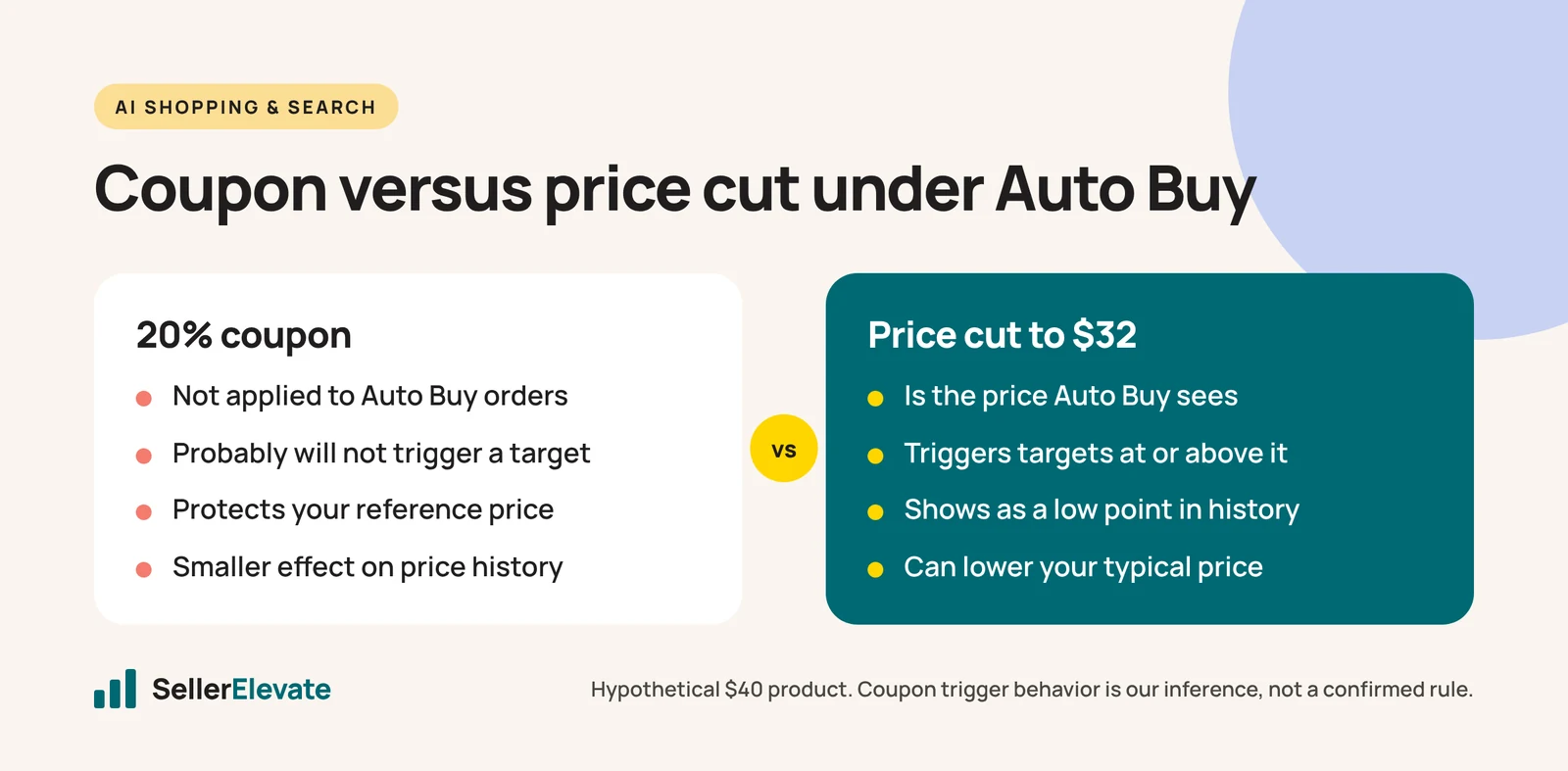
Compare two ways of offering the same discount on a hypothetical $40 product:
| 20% coupon | Price cut to $32 | |
|---|---|---|
| Price the shopper pays (normal checkout) | $32 after clipping | $32 |
| Applied to an Auto Buy order? | No, per My Amazon Guy and PCWorld | Yes, it is the price |
| Likely to trigger a $32 Auto Buy target? | Probably not (our inference) | Yes |
| Shows in 365-day price history | Unclear | Yes, as a low point |
| Effect on future reference prices | Smaller | Can lower your typical price |
Neither column is always right. A coupon protects your price history and your reference price. A price cut catches the Auto Buy shoppers who were waiting for exactly that number. The trade-off is real, and it ties into Amazon’s tightened rules on List Price and Typical Price, which we cover in why your strikethrough price disappeared.
EcomCrew reports that Auto Buy users save an average of 20% per purchase. If that holds, many Auto Buy targets will cluster around a 20% discount, which is also a common Q4 deal depth.
What does Auto Buy mean for repricing?
Three effects, in order of how much they worry us.
Your floor price becomes a trigger, not just a floor. If a repricer drops your price to its minimum for an hour, every Auto Buy request set at or above that minimum can fire, one unit each, within about 30 minutes. A brief price dip used to cost you a few sales at a low margin. Now it can also clear a backlog of waiting orders at that margin. Set floors you are genuinely happy to sell at in volume.
Erratic prices are now visible. With 365 days of price history available on request, a shopper can see every spike and dip. EcomCrew argues that erratic price histories can lead the assistant to steer shoppers toward waiting. ZonGuru’s Q4 guidance (August 2026) recommends keeping a clean price record on hero ASINs for 60 to 90 days before an event. That matches our own view in your price is doing more work than your ads.
Merchant-fulfilled offers miss out. If your FBM offer is the only one on a listing, Auto Buy shoppers apparently cannot use it. For a fast-moving Q4 product, that is one more reason to keep FBA inventory in stock.
A worked example, with hypothetical numbers: you sell a $30 product with a 35% margin, so each sale earns $10.50 before ads. Your repricer floor is $24. At $24 your margin is $4.50. If 200 shoppers have Auto Buy targets between $24 and $26 and the repricer touches $24 for one afternoon, you could sell 200 units at roughly $4.50 each without spending a cent on ads, which is fine, unless those were shoppers who would have paid $30 next week.
What we'd do this week
Prime Big Deal Days starts October 6, 2026, with deals dropping three times a day (midnight, 8 a.m. and 1 p.m. PDT, per PPC Land). Here is the checklist we are running for clients:
- Audit repricer floors on every FBA ASIN. Raise any floor you would not accept at volume.
- Decide coupon versus price cut per ASIN. Use a price cut where you want Auto Buy volume. Use a coupon where you want to protect your reference price.
- Look at your own 365-day price history in the assistant, the way a shopper would. Remove any unexplained spikes before Black Friday.
- Check FBA stock for hero ASINs through the event. Auto Buy only works on items fulfilled by Amazon.
- Watch for clustered orders. After the event, pull orders by hour. A burst of single-unit orders at one price point shortly after a price change is a likely Auto Buy signature.
- Plan Black Friday with the same logic. Our Prime Big Deal Days playbook and BFCM discount strategy cover the rest.
Auto Buy is one part of the wider assistant. For the full picture, read Rufus is gone: what Alexa for Shopping changes. If you want help setting floors and deal mechanics by ASIN, that is part of our account management work.
Frequently asked questions
Can shoppers cancel an Auto Buy order?
Yes, within a limited window. Reports from My Amazon Guy, Techlicious and PCWorld say shoppers have 24 hours after the order is placed to cancel before it ships. After that, normal Amazon return policies apply. Sellers should expect some cancellations on orders placed by Auto Buy.
Does Auto Buy work for merchant-fulfilled offers?
It appears not. Every source we opened says Auto Buy only works on items fulfilled by Amazon, and requires a Prime membership. That should include FBA offers from third-party sellers, but merchant-fulfilled offers seem to be excluded. Amazon has not published a seller-facing rule we could find, so confirm in Seller Central.
How long does an Auto Buy request stay active?
EcomCrew reports that requests stay active for up to six months. PCWorld reports a limit of 200 simultaneous Auto Buy orders per shopper, and each request covers one unit with one active request per item. That means demand can build quietly at a price point for months before it fires.
How can I tell if my sales came from Auto Buy?
Amazon does not label them in any report we found. A likely signature is a burst of single-unit orders at one price point shortly after a price change. Pull orders by hour after an event or repricer move and look for that pattern.
Sources
- My Amazon Guy: Amazon Add to Auto Buy button (May 6, 2026)
- EcomCrew: Amazon’s Rufus can now buy things for you (May 7, 2026)
- Techlicious: Alexa for Shopping price tracking and Auto Buy (May 20, 2026)
- PCWorld: Alexa has a Prime Day superpower, use it with caution (Jun 23, 2026)
- ZonGuru: Amazon Q4 preparation for Alexa for Shopping (Aug 31, 2026)
- PPC Land: Prime Big Deal Days set for October 6-7 across 22 countries (Sep 19, 2026)
Get the honest version of your numbers
A free account audit from the person who would actually run your account.