What happened to Rufus on Amazon and what is Alexa for Shopping?
Amazon retired Rufus on May 13, 2026 and merged it with Alexa+ into Alexa for Shopping. It answers conversational questions in the main search bar on the app, website and Echo Show, without needing Prime. For sellers, it means more shoppers see a short list of named products instead of a full page of results.
Key takeaways
- Amazon renamed Rufus to Alexa for Shopping on May 13, 2026 and moved it into the main search bar.
- Outside research describes the assistant compressing a page of 50 results to about five named products, so being recommended matters more than ranking position.
- Amazon says the assistant draws on the catalog, customer reviews, community Q&As and information from across the web.
- Sponsored Prompts, the ads inside the assistant, became billable on March 25, 2026 and US campaigns are enrolled automatically.
- The fastest test is to ask the assistant your customers' questions and note whether your product is named.
Rufus did not disappear so much as get absorbed. On May 13, 2026, Amazon merged its Rufus chatbot with Alexa+ and relaunched the combined assistant as Alexa for Shopping, which now answers conversational questions directly in the main Amazon search bar instead of in a separate chat window.
For sellers, the important part is not the new name. It is that a growing share of shoppers now get a short list of named products from an assistant instead of a page of results, and the rules for being on that short list are different from the rules for ranking.
What happened to Rufus?
Amazon announced Alexa for Shopping on May 13, 2026, with a US rollout over the following week across the Amazon Shopping app, Amazon.com and Echo Show devices, according to EcomCrew and eMarketer. Amazon’s original Rufus announcement page now carries a notice that says, in effect, Rufus was renamed Alexa for Shopping on that date.
Shoppers do not need Prime, an Echo device or an Alexa subscription to use it. A conversation can start on an Echo and continue on a phone or laptop.
Modern Retail reported the reasoning plainly: Amazon had two assistants doing overlapping jobs, and Alexa was the stronger brand. The visible changes were small. The Rufus chat bubble was replaced by a cursive “A” logo, AI-generated summaries appear at the top of some search results, and the assistant sits more prominently in the search bar.
Sources differ slightly on when it became the default. Bloomberg reported on May 13 that the assistant would appear by default in search “beginning this week”, replacing the old step of tapping the Rufus icon. A June 15 analysis from Novadata describes June 14 as the point it became the default in-search assistant. Either way, by mid-June it was no longer something a shopper had to go looking for.
Here is the short timeline from sources we opened:
| Date | What happened |
|---|---|
| Feb 1, 2024 | Rufus announced in beta for select US app users |
| Jul 12, 2024 | Rufus expands to all US customers |
| Nov 11, 2025 | Sponsored Prompts (ads inside the assistant) open as a free beta |
| Mar 25, 2026 | Sponsored Prompts become billable on cost per click |
| May 1, 2026 | Price history expanded to 365 days |
| May 13, 2026 | Rufus retired, Alexa for Shopping launches in the US |
| Oct 6-7, 2026 | Prime Big Deal Days, with Alexa for Shopping deal alerts and Auto Buy promoted |
What does Alexa for Shopping actually do?
The feature list is longer than Rufus’s. As reported at launch by eMarketer, EcomCrew and PPC Land:
- Conversational search in the main search bar, including product comparisons and delivery questions.
- Scheduled Actions, such as restocking on a schedule or buying when a price drops to a set level.
- A full year of price history on hundreds of millions of products.
- AI shopping guides and overviews on search and product pages.
- Cart building by conversation, referencing past orders.
- Buy for Me, which completes purchases on other retailers’ websites using the shopper’s stored details.
Two of these deserve their own attention. The price features (365-day history and Auto Buy) change how deals and repricing work, which we cover in Amazon Add to Auto Buy. Buy for Me matters if you also sell on your own website, which we cover in our Buy for Me opt-out guide.
The scale is the reason to take this seriously. Amazon-reported figures, as covered by Modern Retail, put Rufus at 300 million customers in 2025 and $12 billion in incremental annualized sales, with Rufus users 60% more likely to complete a purchase. EcomCrew adds that Rufus was involved in 38% of Black Friday 2025 sessions. These are Amazon’s own numbers or secondary reports of them, so treat them as directional rather than audited.
Why does it matter that the assistant names about five products?
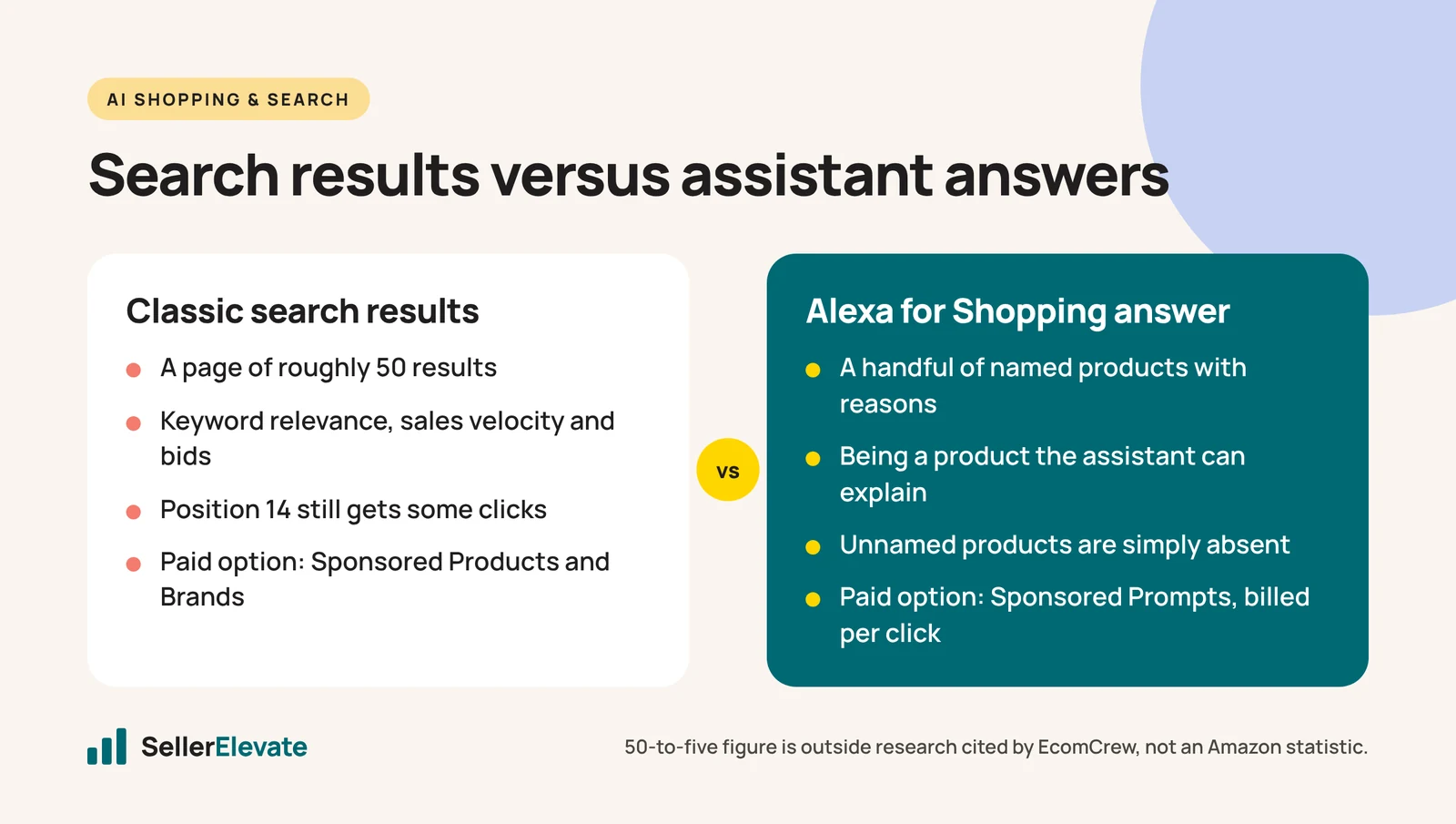
EcomCrew, citing April 2026 research by Workflow Labs, describes the assistant as compressing product discovery “from a traditional page of 50 results to approximately five named products”. That is a characterization from outside research, not an Amazon statistic, but it matches what we see when we test conversational queries in our clients’ categories.
The practical shift looks like this:
| Classic search results | Alexa for Shopping answer | |
|---|---|---|
| What the shopper sees | A page of roughly 50 results | A handful of named products with reasons |
| What gets you seen | Keyword relevance, sales velocity, ad bids | Being a product the assistant can explain and justify |
| Position 14 | Still gets some clicks | Usually not mentioned at all |
| What hurts you | Weak title, poor main image | Missing facts, vague bullets, negative review themes, erratic pricing |
| Paid option | Sponsored Products and Brands | Sponsored Prompts, billed per click |
Ranking used to be a gradient. Being recommended is closer to a yes or no. If a shopper asks “which of these fits a 2019 Honda CR-V?” and your listing never states compatibility, you are not ranked lower. You are absent from the answer.
Amazon’s own description of Rufus is the most useful clue we have about where the assistant looks: it was trained on “Amazon’s extensive product catalog, customer reviews, community Q&As, and information from across the web”. It does not tell us how those inputs are weighed. Anyone selling a precise “Alexa algorithm” formula is guessing, and so would we be.
One knock-on effect to watch: if the assistant answers a shopper’s question in search, fewer people may need to click through to your detail page. Novadata’s analysis calls “sessions decline with a stable or improving BSR” the fingerprint of pre-answered traffic. That comes from a single vendor source, but it is a cheap thing to check in your own Business Reports.
Does the Rufus name still matter?
For shoppers, no. For sellers, mostly as a search term. People still type “Rufus” into Google when they want listing advice, and much of the 2025 guidance written under that name still applies, because the underlying system did not change much in May. The name and the surface changed. The way it reads your listing, as far as anyone outside Amazon can tell, did not.
Two things did change for advertisers. Ads inside the assistant, called Sponsored Prompts, became billable on March 25, 2026, and US Sponsored Products and Sponsored Brands campaigns are enrolled automatically. If you have not looked at the Prompts tab in your ad console, you may already be paying for clicks you have never reviewed. We explain how to find and judge them in Amazon Sponsored Prompts.
What we'd do this week
Prime Big Deal Days runs October 6 and 7, 2026, and the assistant is part of how Amazon is promoting it. Here is the order we would work in:
- Ask the assistant about your own product. Use the Amazon app, logged in as a shopper. Ask the three or four questions a real buyer asks in your category, and note whether your product is named, and what reason is given.
- Ask it about your competitors. When a competitor is recommended and you are not, read the reason it gives. That reason usually points to a fact your listing does not state.
- Check the Prompts tab in your ad console (Campaign, then Ad Group, then Ads, then Prompts) and see what you have been charged for since March 25.
- Pull sessions and BSR side by side for your top ten ASINs, weekly, back to May. Note any ASIN where sessions fell but rank held.
- Look at your 365-day price history the way a shopper now can. A fake “was” price is now visible to anyone who asks.
- Fix the listing gaps the assistant exposed, starting with your best sellers. Our step-by-step is in how to optimize a listing for Alexa for Shopping.
None of this needs a new tool. It needs someone to spend an hour asking the assistant honest questions and writing down what it says.
What we would not overreact to
Organic search has not been switched off. Simple, short queries still return standard results, and classic ranking factors still apply to them. Sponsored Products still run. Your listing still needs a strong title, main image and price.
What has changed is that the questions shoppers used to answer for themselves by reading five listings are increasingly answered by the assistant reading those listings for them. A listing that was written to be skimmed by a person now also has to be read accurately by a machine. In our experience the two goals overlap far more than they conflict: the facts a careful shopper wants are the facts the assistant needs.
Amazon is also still rewriting listing content on its own, which adds a second reason to watch your pages closely. See why Amazon’s AI is rewriting listings for how to spot it.
If you want a second pair of eyes on how your catalog shows up in assistant answers, that is part of our account audit.
Frequently asked questions
Is Rufus still available on Amazon?
No, not under that name. Amazon renamed Rufus to Alexa for Shopping on May 13, 2026, and its original Rufus announcement now carries a rename notice. The assistant still answers shopping questions, but it now sits in the main search bar with a cursive "A" logo instead of the old chat bubble.
Do shoppers need Prime or an Echo to use Alexa for Shopping?
No. According to launch coverage from EcomCrew and eMarketer, Alexa for Shopping works on the Amazon Shopping app, Amazon.com and Echo Show without a Prime membership, an Echo device or an Alexa subscription. A conversation can start on an Echo and continue on a phone or laptop.
How many people used Rufus before the change?
Amazon-reported figures, as covered by Modern Retail, put Rufus at 300 million customers in 2025 and $12 billion in incremental annualized sales, with users 60% more likely to complete a purchase. These are Amazon's own numbers or secondary reports of them, so treat them as directional rather than audited.
Does Alexa for Shopping replace normal Amazon search results?
Not entirely. Simple, short queries still return standard results, and classic ranking factors still apply to them. Conversational questions, comparisons and detailed requests are where the assistant answers with a short list of named products. Sellers now need to perform in both, and the two goals largely overlap.
Sources
- EcomCrew: Amazon retires Rufus and launches Alexa for Shopping as its unified AI assistant (May 13, 2026)
- eMarketer: Amazon’s Alexa for Shopping integrates Rufus (May 13, 2026)
- Modern Retail: Why Amazon discontinued its Rufus chatbot (May 14, 2026)
- PPC Land: Amazon merges Rufus and Alexa into one shopping assistant (May 13, 2026)
- Bloomberg Law: Amazon puts Alexa inside the shopping search bar (May 13, 2026)
- About Amazon: Amazon Rufus announcement, with rename notice (Feb 1, 2024)
- Novadata: Rufus becomes Alexa for Shopping default in search (Jun 15, 2026)
- PPC Land: Prime Big Deal Days set for October 6-7 (Sep 19, 2026)
Get the honest version of your numbers
A free account audit from the person who would actually run your account.