
How do I remove a fake IP complaint a competitor filed on Amazon?
Dispute it with documents that prove your rights or sourcing, send the complainant one written retraction request citing the ASIN and complaint ID, and ask Amazon to review the complainant for abuse. Never pay for a retraction. If complaints repeat, have a lawyer demand substantiation and withdrawal.
Key takeaways
- Check your own listing first, because many complaints that look false trace back to your own content.
- Never pay a complainant to retract; keep any payment demand as evidence of a bad-faith claim.
- A dispute succeeds when it reads like a sourcing file, not an argument about motives.
- Repeat complaints from the same source justify a lawyer's demand for substantiation and, in some cases, civil claims.
If a competitor filed a false IP complaint against your Amazon listing, you have three levers: dispute it with Amazon using documents, ask the complainant to retract it, and if they won’t, apply legal pressure through a lawyer. Never pay a “rights owner” to withdraw a complaint, and never acknowledge a complaint you believe is false.
The process is slow and frustrating, and Amazon does not always get it right the first time. Here is how we handle it.
How do I know the complaint is actually false?
Before you call it abuse, check that it is not a real problem with your listing. A surprising number of “false” complaints turn out to be a competitor’s brand name sitting in the search terms, or a supplier photo that someone else owns. Our guide on responding to an IP complaint covers that check.
Traverse Legal lists warning signs that a complaint is being used as a weapon rather than as genuine enforcement, in its article on false counterfeit claims:
- A complaint hits several ASINs within hours.
- A complaint lands right after you win the Buy Box or change the price.
- It targets listing content rather than product authenticity.
- It repeats after the same issue was already corrected.
Other signs we look for:
- The complainant’s name does not match the owner of the trademark or patent they cite. Check the USPTO or relevant trademark office record.
- The patent cited does not cover your product, or the design patent shows something visibly different.
- The contact is a free email address rather than a company domain or a law firm.
- The complainant asks you for money to withdraw it.
If two or more of these apply and your own content is clean, treat it as a false complaint. If none apply and the complainant is a known brand with a real registration, assume it may be a mistake rather than malice, and lead with a polite retraction request instead of an abuse report. Getting the tone wrong with a legitimate brand turns a quick withdrawal into a standoff.
Should I pay them to retract it?
No. Sellers on the Amazon forums describe “rights owners” writing from personal email accounts and offering to withdraw a complaint for a fee. Paying does three bad things: it funds the scheme, it tells them you will pay again, and it does nothing to stop a second complaint next month on another ASIN.
Instead, keep every message they send. A demand for payment in exchange for a retraction is evidence that the complaint is not a good-faith IP claim. That evidence is useful in your Amazon dispute and to any lawyer you hire.
How do I get Amazon to reinstate the listing?
Work two tracks at the same time.
Track one: dispute with documents. Use the dispute option in the notice and send a file that reads like proof, not an argument. Traverse Legal puts it well: your appeal succeeds when it reads like a sourcing file, not a debate. Include:
- Your trademark registration or Brand Registry status, if it is your brand.
- Invoices from your manufacturer or an authorized distributor, if authenticity is questioned.
- Evidence the cited IP does not belong to the complainant (a screenshot of the trademark record showing a different owner, for example).
- For a patent claim, a short side-by-side showing how your product differs, ideally backed by a patent attorney’s opinion letter.
- A one-paragraph request that Amazon review the complainant for abuse of the notice process, with any payment demand attached.
Track two: request a retraction. Send the complainant a short, firm, written request to withdraw, referencing the ASIN and complaint ID. If they are a real business that made a mistake, this is often the fastest fix.
Expect the process to be inconsistent. One seller in an Amazon Seller Forums thread on repeated false complaints had a first appeal accepted, then an identical second complaint was filed and the second appeal was rejected. Another seller in the same thread described 71 complaints from the same person over two months and said resubmitting copies of the successful appeal usually got the listing reinstated within 24 hours. That is one seller’s experience, not a rule, but it supports what we do: keep the winning dispute file and resubmit it every time.
What if they keep filing complaints?
Repeat filings are where you need to escalate, because each one costs you sales and adds to your account record.
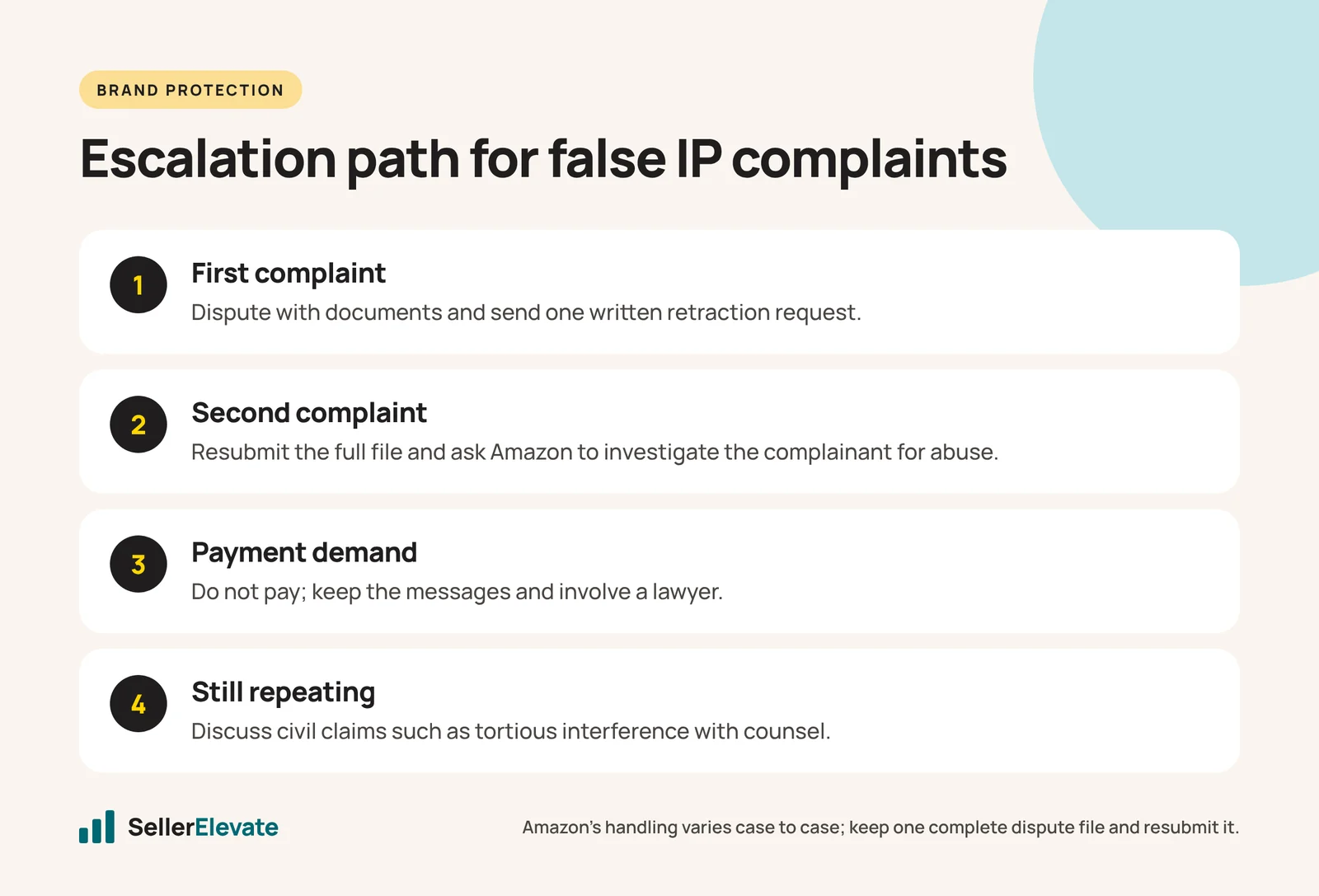
| Situation | Next step |
|---|---|
| First false complaint, clean documents | Dispute with documents and request a retraction |
| Second complaint from the same source | Resubmit the full file, and explicitly ask Amazon to investigate the complainant for abuse |
| Three or more, or a payment demand | Get a lawyer to send a demand for substantiation and retraction |
| Complaints keep coming after a lawyer’s letter | Discuss civil claims with counsel |
On the legal side, Traverse Legal explains that counsel can demand substantiation, ask for retraction and negotiate a withdrawal. Where a repeat reporter knows a claim is false and uses it to push Amazon to cut off your sales, that can create exposure for tortious interference, and depending on the state, defamation. If the complainant hides behind a fake identity, litigation may require subpoenas to identify them. None of that is cheap, so it makes sense when the complaints threaten a meaningful share of revenue.
For utility patent disputes, Amazon has run a neutral patent evaluation program (APEX) where an independent evaluator decides whether a product likely infringes. Eligibility, fees and the current process change, so check the terms in Seller Central or with your patent attorney before relying on it.
How do I stop this happening again?
You cannot stop a bad actor from filing, but you can make your listings harder targets and your disputes faster.
- Register your trademark and enroll in Brand Registry. It is free, and you can enroll once your trademark application is pending. Owning the mark makes trademark complaints against your own brand much easier to defeat.
- Use only original images and copy. Shoot your own photos and keep the raw files with dates. That is your copyright evidence.
- Keep a ready dispute folder per ASIN: trademark certificate, invoices, photo originals, design files, and any patent opinions.
- Monitor your listings daily. A complaint you see on day one costs less than one you notice on day seven.
- Avoid using any other brand’s name in titles, bullets or search terms unless it is a factual compatibility statement.
What we'd do this week
- Confirm the complaint is false by checking your own content and the complainant’s IP record.
- Screenshot everything: the notice, the listing, the complainant’s emails, and the trademark or patent record.
- Submit the dispute with documents and the abuse request the same day.
- Send one written retraction request. Do not negotiate money.
- If this is the second complaint or there was a payment demand, call a lawyer now rather than after the fifth.
If you are dealing with repeated complaints across several ASINs, our listing hijacker removal and account suspension and reinstatement teams work these cases. We will tell you plainly when an appeal is enough and when you need counsel.
Frequently asked questions
Can I report a competitor to Amazon for filing false complaints?
You can ask Amazon to investigate the complainant for abuse of the notice process as part of your dispute or through a Seller Central case, attaching evidence such as payment demands or proof the complainant does not own the cited IP. Amazon's handling is inconsistent, so keep pushing with the same file.
Will a false IP complaint hurt my account health?
An unresolved complaint stays on your record and can count against you, which is why you should dispute it rather than acknowledge it or delete the listing. Once a complaint is retracted or overturned, the listing can be reinstated, so keep the case open until you see that outcome.
How do I check who owns a trademark or patent cited in a complaint?
Search the relevant government register, such as the USPTO for US trademarks and patents. Compare the owner's name with the complainant's name and check whether the patent drawings actually match your product. Screenshot the record for your dispute file, because a mismatch between owner and complainant is strong evidence.
Is it worth suing a competitor over false complaints?
Only when the complaints threaten meaningful revenue and keep coming after a lawyer's letter. Counsel may consider tortious interference or, depending on the state, defamation, and may need subpoenas to identify an anonymous filer. Litigation is expensive, so start with a demand letter.
Sources
- Traverse Legal: False counterfeit claims on Amazon (undated)
- Amazon Seller Forums: Repeated false IP complaints (undated)
- Traverse Legal: Responding to an IP complaint on Amazon (undated)
- Amazon: IP Accelerator (accessed October 2026)
Get the honest version of your numbers
A free account audit from the person who would actually run your account.