What is the best way to finance Q4 inventory: Shopify Capital, Amazon Lending or Wayflyer?
The best offer is the one with the lowest effective annual cost whose repayment term is longer than your cash conversion cycle. A 13% fee repaid over 12 months costs about 25% a year; repaid over six months, about 50%. Convert every flat fee to an annual rate before comparing.
Key takeaways
- Shopify Capital and Amazon Lending offers arrive by invitation, so compare whatever you are actually offered on one basis.
- A 13% fee repaid over 12 months works out to about 25% a year, but about 50% if repaid in six months.
- On sales-linked repayment, strong Q4 sales speed up repayment and raise the effective annual cost.
- Repayment term should be longer than the funded stock's cash conversion cycle, with at least a month of slack.
- Borrow for the units you can sell through in the window, not the amount you were approved for.
The cheapest way to finance Q4 inventory is the offer with the lowest effective annual cost that your cash cycle can actually carry, and that is rarely the one with the smallest headline fee. A 13% fee repaid over 12 months costs roughly half as much per year as the same 13% repaid in six, and a “7% flat fee” repaid in 12 weeks can be the most expensive money on the table.
Below is how the three options most sellers get offered actually work, how to compare them on one number, and what we would do with an offer sitting in your dashboard this week.
Who can get each one, and how do they repay?
All three are built around your sales data, and two of them only come to you by invitation. Here is the short version, as of October 2026, from the providers’ own pages and lender comparisons we read. Terms vary by account and offer, so confirm everything against the actual agreement.
| Shopify Capital | Amazon Lending | Wayflyer | |
|---|---|---|---|
| How you get it | Offer appears in your Shopify admin Finance page; must sell on Shopify at least 90 days | Invitation in Seller Central | Apply; typically $10,000+ average monthly revenue and 6+ months of history |
| Products | Merchant cash advances and loans | Term loans, merchant cash advances, lines of credit through partners | Revenue-based financing |
| Size | Up to $2M | Varies by partner (QuickBooks Capital $1,500 to $250,000; Slope up to $5M) | Typically 1 to 2 times average monthly revenue |
| Cost | Fixed fee (advance) or loan pricing | Interest on loans and lines; fixed capital fee on advances | Fixed fee agreed upfront |
| Repayment | Percentage of daily sales, maximum term 18 months, minimum payments apply | Monthly payments (loans) or share of sales (advances), deducted automatically | Percentage of daily or weekly revenue until repaid |
A few details matter more than the table suggests.
Shopify Capital says on its product page that you “pay it back with a percentage of your store’s daily sales,” the maximum repayment term is 18 months, and “2 minimum payments apply.” Onramp Funds, a competing lender, summarizes the minimums as 30% repaid by month 6 and 60% by month 12, and gives an example of a 13% factor rate on $100,000. Shopify’s Help Center lists eligible countries (US, Canada, UK, Australia and several EU markets) and notes trusts and partnerships are not supported. The pricing detail sits in your offer, not on the public pages.
Amazon Lending now runs mostly through partners. Amazon’s program page names Lendistry, Parafin, QuickBooks Capital, Uncapped, iBusiness Funding and Slope, says decisions usually come in under three business days, and that applying “will not impact your personal credit.” On advances, Amazon states “there is no interest on a merchant cash advance. Sellers pay a fixed capital fee.” That is true, and it is also exactly why you need to convert the fee into an annual rate yourself.
Wayflyer says on its revenue-based financing page that repayments are a percentage of revenue and the total cost is agreed upfront. It does not publish fee levels there. Onramp puts Wayflyer’s fee at “typically 5% to 10%” over 12 to 24 weeks in one guide and “2% to 12%” in another. Treat those as third-party estimates from a competitor, not quotes.
How do you compare a flat fee with an interest rate?
Convert everything to an effective annual cost. You do not need a finance degree for a usable estimate.
When you repay in roughly even installments, your average outstanding balance over the life of the advance is about half the amount you borrowed. So:
Approximate annual cost = fee ÷ (principal ÷ 2) ÷ term in years
Then check it properly with a spreadsheet: list the cash you receive as a positive number on day zero, each expected remittance as a negative number on its date, and run XIRR. We ran the examples below that way, assuming equal daily repayments.
Hypothetical offers on $100,000 of Q4 inventory:
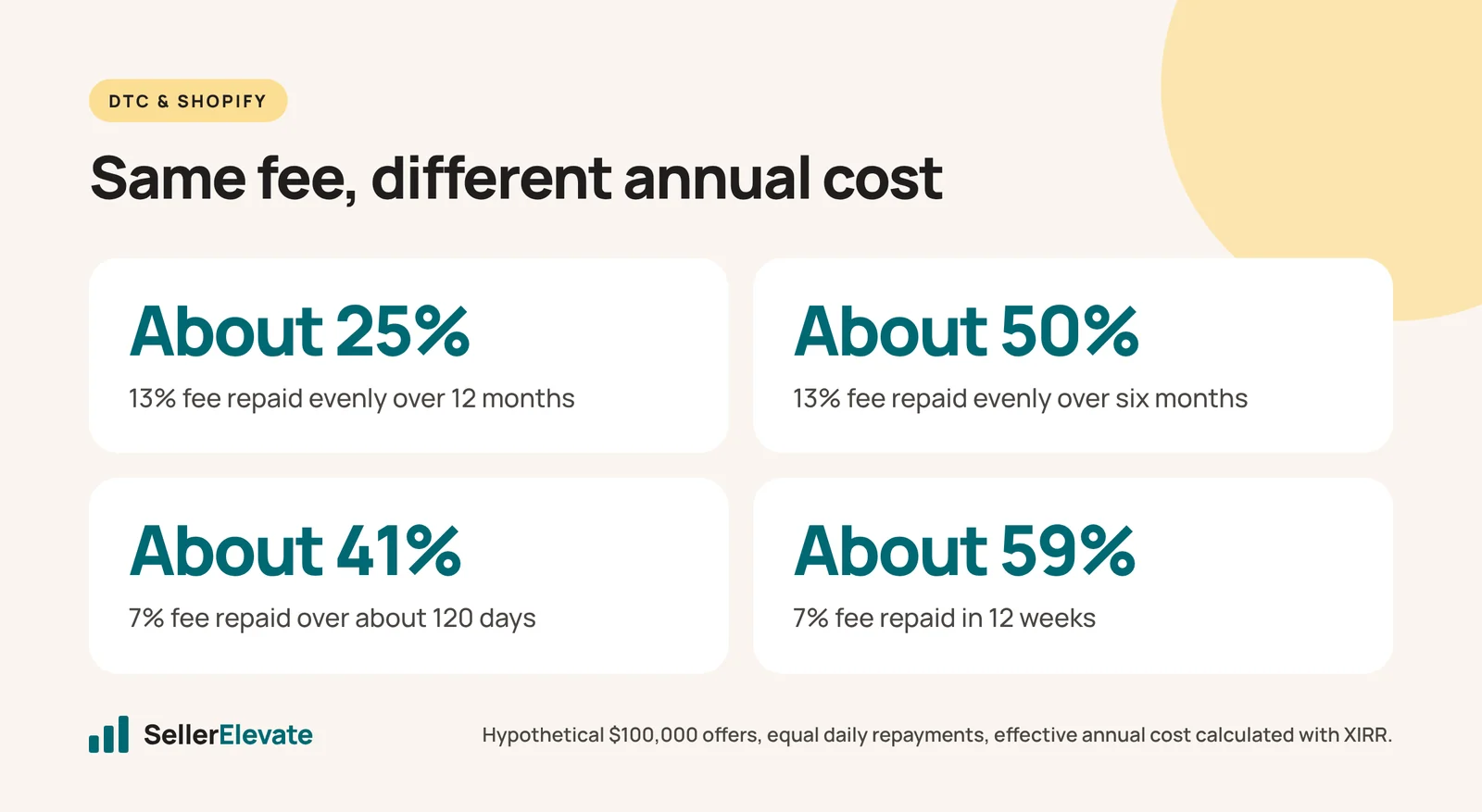
- 13% fee, repaid over 12 months: $13,000 fee. Effective annual cost about 25%.
- 13% fee, repaid over six months: same $13,000. About 50%, because you have the money half as long.
- 7% fee, repaid in about 120 days: $7,000 fee. About 41%.
- 7% fee, repaid in 12 weeks: About 59%.
The “cheap” 7% offer costs more per year than the 13% one at 12 months. And on any sales-linked product, a strong Q4 speeds up repayment and pushes the effective rate up. Good sales make the money more expensive. That is fine if you planned for it and painful if you did not.
A fixed-rate term loan works the other way: the rate is the rate, and early repayment can lower the total cost if there is no prepayment penalty. Ask about prepayment before you sign anything.
Which matters more: the rate or the repayment drag?
For most brands we work with, repayment drag is what causes the damage, not the fee.
Sales-linked remittance takes a slice of every day’s revenue. If your offer takes, say, 12% of daily sales and your contribution margin after ads is 20%, more than half of each day’s contribution goes to the lender while you are also trying to buy January stock, pay Q4 ad bills and absorb returns.
So map the offer against your cash conversion cycle:
- Days to receive stock after you pay the supplier (production plus freight plus check-in)
- Days to sell through at your planned Q4 velocity
- Days until marketplace payouts land (Amazon pays on a cycle; Shopify pays out on its schedule)
If that full cycle is 120 days and the repayment term is 90, you are repaying before the inventory has turned into cash. You will fund the remittance from other products’ cash, which is how one funded SKU starts starving the rest of the catalog.
The rule we use: repayment term should be longer than your cash conversion cycle for the funded stock, with at least a month of slack. If it is not, either borrow less, pick a longer product, or fund a faster-turning SKU.
Which option fits which seller?
There is no universal winner. These are the patterns we see.
- You sell mostly on Amazon and have an Amazon Lending invitation for a term loan: fixed monthly payments are the easiest to plan around, and a stated interest rate is easy to compare. Read which partner is behind the offer and what it requires.
- You sell mostly on Shopify and have a Capital offer: convenient, repayment flexes with slow days, and the 18-month cap gives room for slower-turning stock. Work out the effective rate at your realistic Q4 sales, not your average month.
- You sell across channels, or neither platform has invited you: revenue-based lenders like Wayflyer connect to several sales channels. Ask for the remittance percentage, the total fixed fee and whether repayment is daily or weekly, and run the numbers above.
- You are tempted by an unsolicited “flat fee” advance from a broker: read our breakdown of the true APR behind merchant cash advances first.
Tariffs and higher landed costs have pushed up how much cash a Q4 order needs. That makes it tempting to accept the biggest offer. Borrow for the units you can sell through in the window, not the amount you were approved for.
What we'd do this week
If an offer is sitting in your dashboard right now:
- Pull 12 months of daily sales and your Q4 forecast by SKU. Use last year’s November and December, adjusted for this year’s catalog.
- Write down the cash conversion cycle for the stock you want to fund, in days.
- Model each offer in a spreadsheet with
XIRRat three sales scenarios: forecast, 20% above, 20% below. The high scenario shows your worst effective rate on a sales-linked product. - Check remittance against contribution margin. If remittance takes more than about half your daily contribution in the low scenario, borrow less.
- Confirm inventory deadlines before committing. Funding stock that misses FBA check-in for peak is the most expensive version of this. Our Black Friday 2026 inventory deadlines countdown has the dates we track.
- Price in peak fees. Q4 storage and fulfillment surcharges eat into the margin you are borrowing against; see Q4 2026 Amazon fees.
- Ask every lender the same four questions: total repayment amount, remittance percentage or payment schedule, minimum payment requirements, and prepayment terms. Get them in writing.
Then pick the offer with the lowest effective annual cost whose repayment term clears your cash cycle. If none does, the honest answer may be to order less and protect the account’s cash rather than stretch.
When is outside financing the wrong answer?
Debt amplifies whatever your unit economics already are. If the product has thin margin after ads, high returns or slow sell-through, financing more of it makes the problem bigger and faster.
Before borrowing for Q4, we want to see a contribution margin you can name per unit and a TACoS that holds up when you look at it honestly. Our post on ROAS, MER and contribution margin covers how we set that floor. If you want a second pair of eyes on whether a SKU deserves the capital, our account audit starts with exactly that question.
We are not lenders and we do not take referral fees from any of the providers above. Treat this as a framework for reading offers, not financial advice, and talk to your accountant before signing.
Frequently asked questions
Is Shopify Capital invitation only?
Effectively, yes. Shopify says it emails merchants who are eligible to apply and that offers appear on the Finance page of the Shopify admin. You need to have sold on Shopify for at least 90 days, and trusts and partnerships are not supported.
Does applying for Amazon Lending affect my credit?
Amazon's program page says applying for financing in the Amazon Lending program will not impact your personal credit. Offers come through partners such as Lendistry, Parafin, QuickBooks Capital, Uncapped, iBusiness Funding and Slope, and each partner's terms differ, so read the agreement.
How much can Wayflyer lend?
Wayflyer says offer sizes typically range from 1 to 2 times your average monthly revenue, and it typically works with brands doing at least $10,000 a month with six months of history. It does not publish fee levels on its financing page, so get the total fixed fee in writing.
Can I repay a sales-linked advance early to save money?
Usually not. On a fixed-fee advance the fee is set upfront, so paying early raises your effective annual rate rather than lowering the cost. A term loan without a prepayment penalty is different. Ask each lender about prepayment terms before you sign.
Sources
- Shopify: Shopify Capital (accessed October 2026)
- Shopify Help Center: Shopify Capital (accessed October 2026)
- Amazon: Amazon Lending program (accessed October 2026)
- Wayflyer: Revenue-based financing (accessed October 2026)
- Onramp Funds: Shopify Capital alternatives in 2026 (September 15, 2026)
- Onramp Funds: Marketplace seller funding, Amazon vs Walmart vs Shopify (undated)
- Eva: Amazon Seller Lending program (undated)
Get the honest version of your numbers
A free account audit from the person who would actually run your account.