Why does customer retention matter for Amazon sellers?
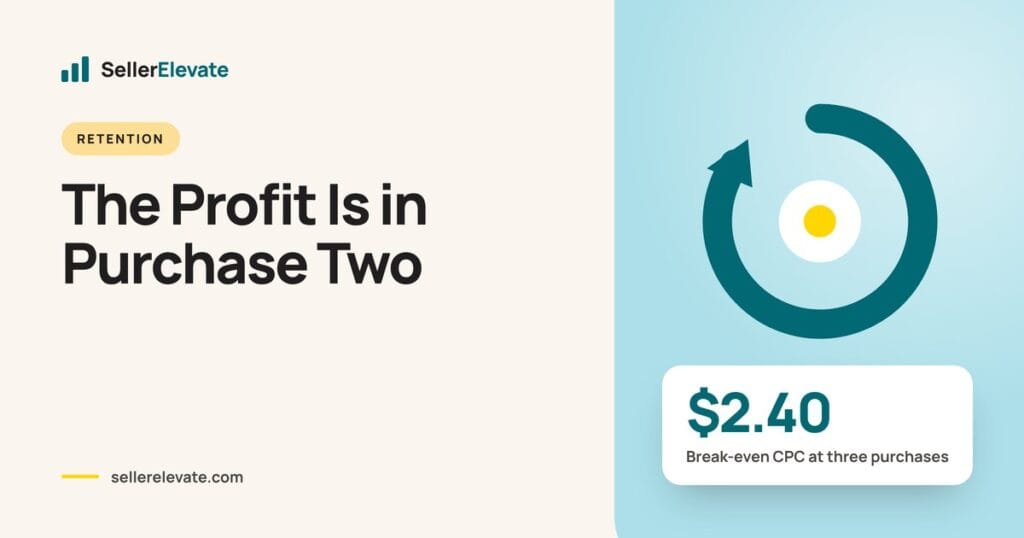
Because repeat buyers change what you can afford to bid. With an $8 margin and a 10% conversion rate, break-even CPC is $0.80 for a one-time buyer but $2.40 if they buy three times. Subscribe & Save, Brand Tailored Promotions and retargeting drive repeat orders, but only for a product worth buying twice.
Key takeaways
- An $8 margin at a 10% conversion rate gives a break-even CPC of $0.80, but $2.40 if each customer buys three times.
- Subscribe & Save lets you set a seller-funded discount of 0%, 5% or 10%, and leaving it at 0% means essentially nobody subscribes.
- Brand Tailored Promotions offer segment-specific discounts of 10 to 50% with no platform fee, and each segment needs a different level of discount.
- Match retargeting windows to the product's replenishment cycle, because ads shown weeks before a customer needs more have no chance of converting.
- Retention tools amplify an existing reason to buy again; they cannot create one if the product is not worth repurchasing.
Most Amazon brands are built entirely around acquisition. Better keywords, better bids, better images, more traffic. All of it aimed at one event: a stranger buying something once.
Then that customer disappears, and the brand pays again — through advertising — to replace them with another stranger who will also disappear.
That is a treadmill, and it is why so many accounts grow revenue without ever growing profit.
How do repeat purchases change your break-even CPC?
We have written before about break-even CPC: your contribution margin per unit multiplied by your conversion rate. An $8 margin at a 10% conversion rate gives you a break-even cost per click of $0.80.
That formula assumes each customer buys once. Now run it again assuming they buy three times.
Same $8 margin per unit, but the customer is now worth $24 of contribution across the relationship, and only the first purchase carried an acquisition cost. Your break-even CPC becomes $2.40.
You can afford to bid three times higher than a competitor who only counts the first sale. That is not a clever trick. It is the entire reason “optimise for lifetime value, not ACoS” is more than a slogan — it changes what you are allowed to pay for traffic, which changes which keywords you can win, which changes your rank.
It also explains something that confuses a lot of sellers: how a competitor apparently bidding uneconomically keeps outranking them. Often they are not being reckless. They are counting a different number.
Amazon gives you three retention tools. Most brands use none of them properly.
Subscribe & Save
The closest thing Seller Central offers to recurring revenue, and the one most commonly left switched on but doing nothing.
What it requires: Brand Registry enrolment, a Professional account in good standing, roughly three months of selling history, strong seller feedback, and an in-stock rate above 90%. It is no longer FBA-only — merchant-fulfilled sellers can enrol products individually once they meet the delivery requirements.
The setting that matters: you choose the seller-funded discount, and the options are 0%, 5% or 10%. An enormous number of brands leave it at 0%, which means the badge appears and essentially nobody subscribes. That single field is the difference between a real subscription programme and a decoration. Reported figures suggest a 10 to 15% total discount can drive up to 1.8x conversion, and subscription cohorts commonly show repeat rates above 30%.
Worth knowing: if a customer has five or more products in a single Subscribe & Save delivery, Amazon funds an extra 5% discount on all of them. That is Amazon’s margin, not yours, and it is a reason to think about which of your SKUs could travel together in one delivery.
Where it genuinely does not work: one-time purchases. Supplements, coffee, pet food, household consumables, beauty refills, baby products — yes. A frying pan, a desk lamp, a suitcase — no. If your category is durable, skip this section entirely and go to bundles and cross-sell instead, because forcing a subscription onto a product nobody replenishes just gives away margin.
Brand Tailored Promotions
Segment-specific discounts, 10 to 50%, with no platform fee — you fund only the discount. It requires Brand Registry and a Brand Representative role, and it sits under Advertising in Seller Central.
The trap is using one discount across every segment. Different customers need different amounts of persuasion, and some need none:
- Brand followers opted in already. 5 to 10% is plenty.
- Repeat customers were probably going to reorder anyway. Cap around 5 to 8%, and only on bundles or larger pack sizes — never on the exact SKU they already buy on a schedule.
- Recent customers are worth 10 to 15%, but on an adjacent product, not the one they just bought.
- High-spend customers are price-insensitive by definition. 5%, on premium or new products.
- Lapsed and at-risk customers are where aggressive discounting earns its keep. 15 to 20% is justified, because winning back a buyer you have already paid to acquire is cheaper than acquiring a new one.
- Cart abandoners convert best of any segment. 10 to 15%, time-boxed to about seven days to create urgency.
The principle underneath all of it: a tailored discount is still a discount, and it only earns its place when the sale would not have happened otherwise. Handing 10% to someone who was already reaching for the reorder button is just margin you gave away with extra steps.
Sponsored Display and Amazon DSP retargeting
This is where retention becomes an advertising job rather than a promotions one.
Build separate audiences for separate problems: people who viewed but did not buy, one-time purchasers who could be upgraded to a subscription, and cancelled subscribers who need winning back. Each needs different creative and a different offer.
Match the retargeting window to the replenishment cycle. This is the part most brands get wrong. A product consumed every thirty days needs a much shorter window than a skincare product used over sixty, which needs a shorter window than something seasonal. Retargeting someone three weeks before they could possibly need more is spend with no chance of converting.
What retention metrics should Amazon sellers track?
Retention is invisible in the metrics most sellers watch. ACoS, ROAS and unit session percentage all describe single transactions. None of them tells you whether anyone came back.
The four that matter here:
Repeat purchase rate. What share of buyers ordered again within your product’s natural replenishment window.
Cost per repeat order. What you spent on promotions and retargeting to produce each additional purchase. It should be dramatically lower than your cost to acquire a new customer. If it isn’t, something is wrong with the targeting.
Customer lifetime value. Total contribution margin across the relationship. This is the number that should be governing your bids.
Churn, specifically subscription cancellations after the first delivery. A spike there is not a marketing problem. It means the product did not match what the listing promised, and no discount fixes that.
The part nobody wants to hear
All of this assumes the product is worth buying twice.
Retention tooling amplifies an existing reason to return. It cannot manufacture one. If your repeat rate is near zero, the honest first question is not “which retargeting audience should we build” — it is whether anyone actually wants this product again, and if not, why.
We have seen exactly that pattern on TikTok Shop, where a shop with seventy-nine recent customers had fewer than one repeat buyer. Impulse channels acquire brilliantly and retain terribly, because nobody who bought had chosen the brand in the first place.
The uncomfortable version applies on Amazon too. If cancellations spike after delivery one, the fix is upstream in the product, the pack size or the price — not in the promotion settings.
Why does retention compound on Amazon?
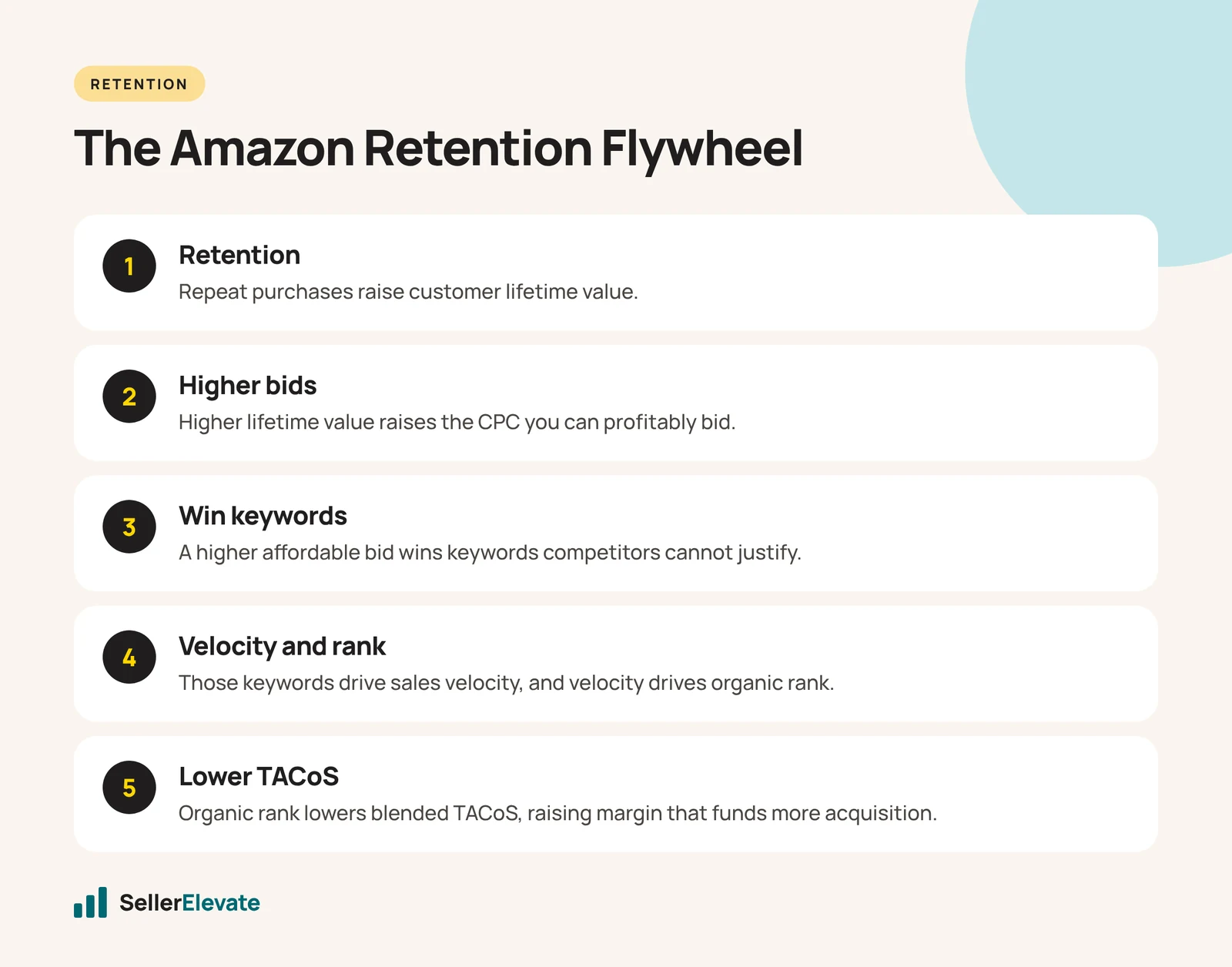
Here is the flywheel, stated plainly.
Retention raises lifetime value. Higher lifetime value raises the CPC you can profitably bid. A higher affordable bid wins keywords your competitors cannot justify. Winning those keywords drives sales velocity. Velocity drives organic rank. Organic rank lowers your blended TACoS, which raises margin, which funds more acquisition.
Every part of that loop starts with the second purchase. Which is why the brands that scale profitably are almost never the ones with the cleverest ad account. They are the ones who built something worth buying again, and then made buying it again effortless.
Repeat purchase rate and subscription performance are part of what we look at in a free account audit, alongside the advertising — because as the maths above shows, they are the same conversation.
Frequently asked questions
What are the requirements for Amazon Subscribe & Save?
You need Brand Registry enrollment, a Professional account in good standing, roughly three months of selling history, strong seller feedback and an in-stock rate above 90%. It is no longer FBA-only, so merchant-fulfilled sellers can enroll products individually once they meet the delivery requirements. Check Seller Central for the current eligibility rules before enrolling.
What Subscribe & Save discount should I offer?
Not 0%. You choose a seller-funded discount of 0%, 5% or 10%, and at 0% the badge appears but essentially nobody subscribes. Reported figures suggest a 10 to 15% total discount can drive up to 1.8x conversion. If a customer has five or more products in one delivery, Amazon funds an extra 5% discount on all of them.
How should I set Brand Tailored Promotions discounts by segment?
Match the discount to how much persuasion each segment needs. A sensible split is 5 to 10% for brand followers, 5 to 8% for repeat customers on bundles only, 10 to 15% on an adjacent product for recent customers, 5% for high-spend customers, 15 to 20% for lapsed customers, and 10 to 15% for cart abandoners, time-boxed to about seven days.
Which metrics show whether Amazon customers come back?
ACoS, ROAS and unit session percentage describe single transactions, so they cannot show retention. Track repeat purchase rate within the replenishment window, cost per repeat order, customer lifetime value in contribution margin, and subscription cancellations after the first delivery. A spike in early cancellations usually means the product did not match what the listing promised.
Get the honest version of your numbers
A free account audit from the person who would actually run your account.