How much of my marketing budget should go to brand vs performance?
It depends on stage. As a starting point we use about 10 to 20% brand before product-market fit, 20 to 35% once unit economics are proven, and 35% or more when paid social has plateaued. Measure brand spend through branded search, Amazon branded queries, new-customer rate and MER.
Key takeaways
- Classify spend by what it is judged on, not by which channel it runs in.
- 1-800-DTC puts average ecommerce CAC up 40 to 60% between 2023 and 2025.
- Tenten reports brands moving from 50%+ paid social dependency to roughly 35 to 40% paid.
- Branded search on Google and branded query volume in Amazon Brand Analytics are the clearest signals of brand spend working.
- Make brand spend measurable with a regional test, or it will be the first budget cut.
There is no single correct split, but there is a correct order: a brand that cannot yet turn paid traffic into profitable first orders should keep most of its budget in performance, and a brand whose paid acquisition costs keep rising at steady spend should move a growing share into brand and owned channels. As a starting point, we use roughly 10 to 20% brand for early-stage brands, 20 to 35% for brands with proven unit economics, and 35% or more for mature brands where paid social has stopped scaling.
Those ranges are our working rule of thumb, not an industry statistic. What makes them useful is the measurement that goes with them, because brand spend you cannot measure gets cut the first bad month.
Why are brands rethinking the split now?
Because the cost of buying a customer through performance channels keeps climbing. Travis Halff of the agency Y’all, writing for 1-800-DTC in April 2026, puts average ecommerce customer acquisition cost up 40 to 60% between 2023 and 2025, now $68 to $84 depending on category. He points to rising demand for ad inventory pushing up CPMs and CPCs, and to privacy changes reducing targeting precision.
Some operators have responded by reducing dependence on paid social. Tenten, a Shopify agency, reports in its 2026 DTC CAC benchmarks that brands in its portfolio moved from 50%+ paid social dependency to roughly 35 to 40% paid, 30% email, 20% organic and community, and 10% affiliate, and that CAC stayed flat while LTV improved by 12 to 18%. That is one agency’s portfolio, not a controlled study, so read it as direction rather than proof.
The underlying logic is simpler than the numbers. Performance channels harvest demand that already exists. When you run out of people who are ready to buy, each extra dollar reaches colder audiences at a higher cost. Brand spend is how you make more people ready to buy later. Les Binet and Peter Field’s work for the IPA, The Long and the Short of It, makes the same warning from the other side: using very short-term online metrics as the primary performance measure has, in the IPA’s words, “dangerous implications for long-term success.”
What counts as brand spend and what counts as performance?
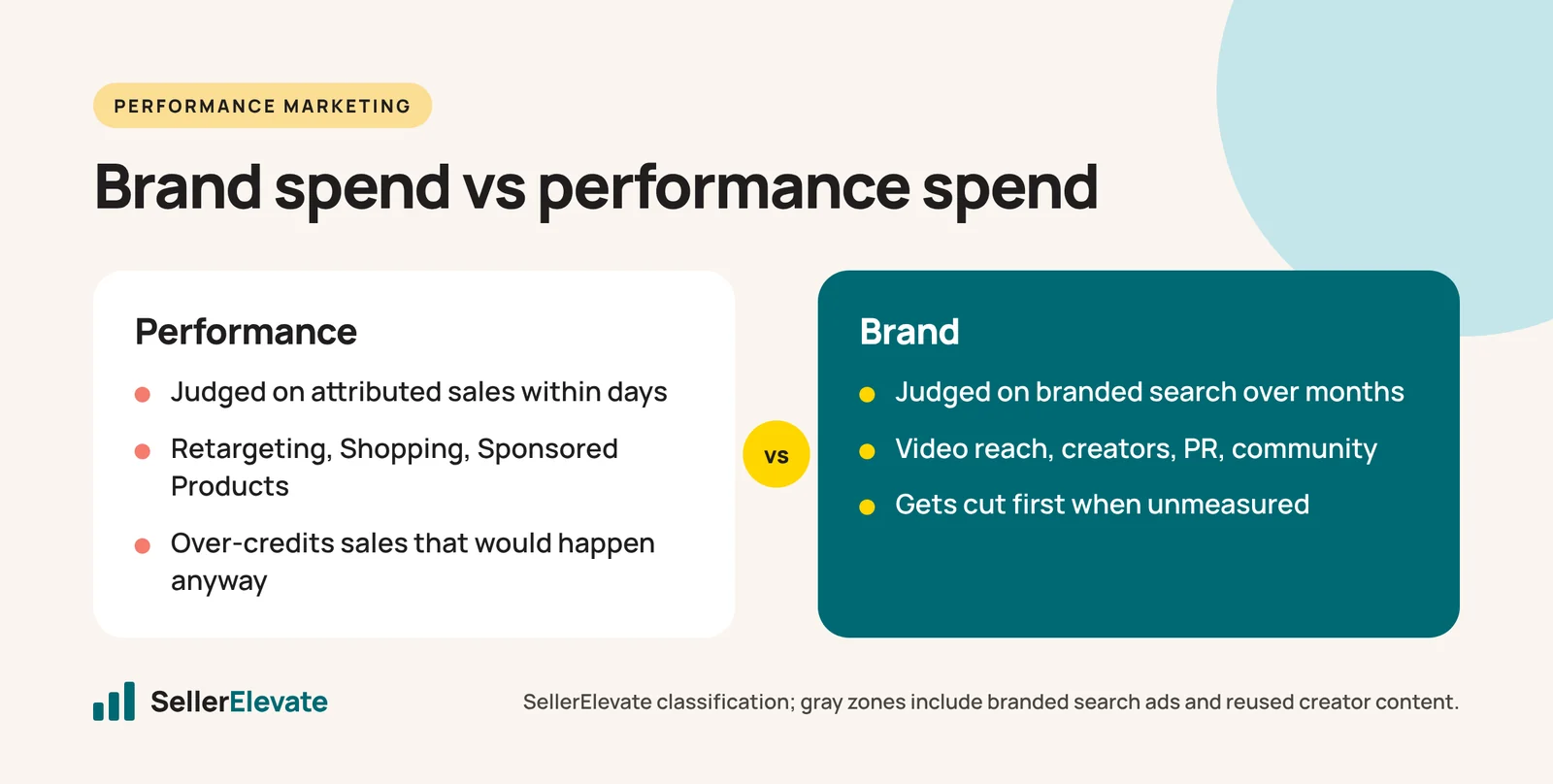
Most budget arguments go wrong here, because the same channel can be either. We classify by what the spend is judged on, not by where it runs.
| Performance spend | Brand spend | |
|---|---|---|
| Judged on | Attributed sales, CPA, ROAS within days | Branded search, direct traffic, new-customer rate over months |
| Typical examples | Retargeting, Shopping and Search ads on non-branded terms, Amazon Sponsored Products, conversion-optimized Meta campaigns | Video reach campaigns, creator partnerships for awareness, PR, sponsorships, content, community |
| Gray zone | Branded search ads, Amazon Sponsored Brands on your own name | Creator content later reused as paid ads |
| Failure mode | Over-credits itself for sales that would have happened anyway | Never gets measured, so it is the first thing cut |
Owned channels such as email and SMS sit on a separate line. They cost little per send but they need list growth, which usually comes from the other two. Halff notes that roughly 60% of DTC revenue comes from returning customers, which is why we never treat retention as an afterthought in the split.
How should the split change by stage?
Here is how we would set the starting point. Every number below is our recommendation, to be adjusted after you measure.
- Pre-product-market fit (under about $50K a month in revenue). Brand 10% or less. Your problem is finding out whether the product converts at all. Spend on performance channels where the feedback is fast, and on creative testing. Halff suggests putting 20 to 30% of the performance budget into creative development and testing, which is a better use of early money than awareness.
- Proven unit economics, still scaling. Brand 20 to 35%. You know your break-even ROAS (see our guide on what ROAS you need to be profitable), first orders are close to break-even or better, and you want the next tier of growth. Start with brand formats that are measurable: creator content, video reach campaigns in a few regions, PR around launches.
- Mature, paid social has plateaued. Brand 35% or more. If spend is flat, CAC is rising and new-customer share is falling, more performance budget mostly buys back customers you already had. This is where the larger shift into brand and owned channels pays.
Two exceptions. If you sell mainly on Amazon, branded search on Amazon is itself a performance channel you can measure, so “brand” spend off Amazon can be judged partly on Amazon results. If you are cash-constrained, payback period wins over everything: Tenten cites a 90 to 120 day payback target, and brand spend lengthens payback by design.
How do you measure brand spend without fooling yourself?
You will not get a ROAS figure for brand spend that you can trust. You can get directional signals that move when brand spend works and stay flat when it does not.
- Branded search volume on Google. Google Search Console impressions for queries containing your brand name, and Google Trends for the brand term. Look at the trend over 8 to 12 weeks, not daily.
- Branded search on Amazon. In Brand Analytics, the Search Query Performance dashboard shows search volume and your share for queries containing your brand. Rising branded query volume after an off-Amazon campaign is one of the cleaner signals available. Our guide to the Search Query Performance dashboard shows where to find it.
- Direct and organic traffic to your site, and organic sessions on Amazon from Business Reports.
- New-customer rate. If brand spend works, the share of orders from first-time customers should hold or rise while CAC from performance channels stops climbing.
- MER (total revenue divided by total marketing spend). A blended number cannot be inflated by a single platform’s attribution.
For a real answer on incrementality, run a test. A geo holdout test (brand spend in some regions, not others) is within reach of a brand spending a few thousand a month, and it beats arguing about attribution.
A worked example
Hypothetical numbers. A skincare brand spends $40,000 a month, 90% on Meta conversion campaigns and branded Google Search, 10% on everything else. Meta CAC has risen from $48 to $61 over six months at the same spend, and new customers are a falling share of orders.
What we would do:
- Move $8,000 a month (20%) into creator content and video reach campaigns, concentrated in three states so it can be measured against the rest of the country.
- Keep branded search and retargeting running, but stop counting them as growth. They mostly capture demand that already exists.
- Track, weekly: branded search impressions in the test states versus the rest, Amazon branded query volume, new-customer CAC and MER.
- Review at 10 to 12 weeks. If branded search in the test states rose meaningfully and blended CAC held flat while total spend stayed level, expand. If nothing moved, change the creative before you blame the channel.
The test costs the same as the budget you already have. Only the allocation changes.
What mistakes make the split worse?
- Counting branded search as performance success. It looks like your best ROAS line because the shopper already knew you. Cutting brand to fund more branded search is circular.
- Judging brand on 7-day attribution. It will always lose. Decide the measures in advance and give them a full quarter.
- Making brand spend unmeasurable. A national awareness burst with no holdout, no baseline and no branded search tracking cannot be defended in a budget meeting.
- Moving money before the funnel converts. As we wrote in PPC is an amplifier, not a fix, more traffic of any kind does not fix a page that does not convert. In that account, ad spend rose 25% after a listing rebuild and net profit rose 81.5%. The rebuild came first.
What we'd do this week
- Classify last quarter’s spend using the table above: performance, brand, owned, gray zone.
- Calculate MER and new-customer CAC for the last six months.
- Pull branded search impressions from Search Console and branded query volume from Amazon Brand Analytics as your baseline.
- Choose your stage honestly, set the split, and pick one region-based brand test you can read in 10 to 12 weeks.
If you want help building the channel plan across Meta, Google and Amazon, our social media marketing team works on exactly that.
Frequently asked questions
Is branded search advertising brand spend or performance spend?
Treat it as a gray zone that mostly captures existing demand. Branded search ads usually show your best ROAS because the shopper already knew you. Keep them running to protect your name, but do not count them as growth or use their ROAS to justify cutting brand-building spend.
How long before brand spend shows results?
Give it a full quarter. We review brand tests at 10 to 12 weeks, watching branded search impressions, Amazon branded query volume, new-customer CAC and MER. Judging brand spend on 7-day attributed sales will always make it look like a loss.
Does email count as brand or performance?
Neither, really. Email and SMS are owned channels on their own line. They cost little per send but depend on list growth from paid and brand activity. Tenten's portfolio example puts about 30% of the mix in email after brands reduced paid social dependency.
What if I sell mainly on Amazon?
Then branded search on Amazon is a performance channel you can measure, and off-Amazon brand spend can be judged partly by Amazon results. Watch the Search Query Performance dashboard for branded query volume before and after a campaign, ideally with a regional holdout.
Sources
- 1-800-DTC: Why is my DTC CAC going up and what to do about it (8 April 2026)
- Tenten: D2C CAC benchmarks 2026 (2026)
- IPA: The Long and the Short of It, Les Binet and Peter Field (accessed October 2026)
Get the honest version of your numbers
A free account audit from the person who would actually run your account.