Should I lower my price to sell more on Amazon?
Not automatically. A price cut almost always increases units, but the real question is whether total contribution margin goes up. Price also sets your break-even ACoS, so a cut shrinks what you can afford to bid. In one cookware audit, listings at both the premium and budget ends won with poor search visibility.
Key takeaways
- Competitive total price is one of four factors Amazon names for the Featured Offer, alongside delivery speed and certainty, order experience and stock availability.
- If your product is cheaper elsewhere, including on your own DTC site, the Featured Offer can be suppressed even with perfect metrics.
- Break-even ACoS equals your contribution margin percentage, so a 10% price cut on a 30% margin product cuts your advertising headroom by a third.
- Experienced private label operators now advise a hard minimum of 20% net margin, set at the research stage before sourcing.
- Discounts are pricing decisions: fund Subscribe & Save properly or skip it, and segment Brand Tailored Promotions instead of using one discount for everyone.
Price is the number sellers change most often and analyse least.
It gets nudged when sales dip, matched when a competitor moves, and discounted when a quarter looks short. Almost nobody treats it as what it actually is on Amazon: the single input that touches every other lever in the account at once.
What does price control on Amazon?
Whether you win the Featured Offer. Amazon names competitive total price as one of four factors in Buy Box selection, alongside delivery speed and certainty, order experience and stock availability. A modestly higher price can still win if the delivery promise is better. A low price can lose outright if you are out of stock.
Whether the Buy Box exists at all. Price parity enforcement has tightened. If Amazon finds your product listed cheaper elsewhere, the Featured Offer can be suppressed even with perfect metrics. Your DTC site running a promotion your Amazon listing does not match is a real and common cause of a Buy Box vanishing overnight.
What you can afford to bid. Break-even ACoS is simply your contribution margin percentage. Every dollar of margin you give away at the price point is a dollar you cannot spend acquiring the customer. Price down and you have quietly reduced the keywords you can afford to compete for.
Conversion rate. Obviously, but not in the direction people assume — which is the interesting part.
Is a cheaper price always better on Amazon?
We ran a competitive audit across eleven listings in the German cookware category. Two of them break the assumption that price and performance move in one direction.
Zwilling sells at €341 against a category median of €109.99. It appears on page one for only 34% of the category’s search volume — the second-lowest coverage in the set. It still produced €229,042, the second-highest revenue in the category, on 638 units.
Redchef’s cheapest listing sells at €56.99. It appears on page one for just 21% of search volume, the lowest in the set. It still moved 1,086 units, more than a competitor with 90% search coverage.
Two listings, at opposite ends of the price range, both with poor visibility, both winning. One is selling brand and quality. The other is selling price. Neither is competing on being findable.
That gives you three distinct ways to win a category: be findable, be trusted, or be cheap. Most brands default to findable because it is the only one they can change this quarter. That is a reasonable choice. It should be a choice, not an accident.
Matching competitors is a decision, and usually the wrong one
Setting your price to the middle of the category is a decision to compete on everything except price — which only works if you have built something else to compete on.
If your images, copy, reviews and delivery promise are all roughly average too, then matching the market price means you have no reason for anyone to pick you. You have entered a race that gets settled by advertising budget, and someone always has a bigger one.
The brands that hold a premium are not doing it because their product costs more to make. They are doing it because something on the page justifies it — a claim the competitors cannot make, a format nobody else offers, a review profile that removes the risk of trying something unfamiliar. Premium pricing is downstream of differentiation, not a substitute for it.
And the payoff compounds. Higher margin means higher break-even ACoS, which means you can outbid the brand charging less for the same keyword, which means you get the traffic and the margin.
What net margin should an Amazon product have?
For private label products in 2026, experienced operators now advise a hard minimum of 20% net margin, set at the research stage, before sourcing.
That is a meaningfully higher bar than a few years ago, and it exists because the cost stack keeps thickening: referral fees, FBA fees up again in January, a fulfilment fuel surcharge, inbound defect fees that jumped from pennies to as much as $1.74 per unit, rising CPCs, and tariffs pushing input costs up 10 to 25% on imported goods.
If your price cannot clear that floor with advertising included, the problem is not the campaign structure. It is that the product was priced into a corner before it ever went live, and no amount of optimisation gets it out.
Discounting is pricing, and it should be as deliberate
Most brands treat discounts as a separate activity from pricing. They are the same decision made twice.
Subscribe & Save lets you fund 0%, 5% or 10%. An enormous number of brands leave it at 0%, so the badge appears and nobody subscribes — which is the worst of both worlds, since you get no retention benefit and the listing still signals that a subscription exists. If the product is genuinely replenishable, fund the discount properly. If it is not replenishable, do not enrol it at all.
Brand Tailored Promotions should never use one discount across every segment. Lapsed and at-risk customers justify 15 to 20%, because winning back a buyer you already paid to acquire is cheap. Repeat customers justify 5 to 8% at most, and only on bundles or larger pack sizes, because they were going to reorder anyway. Discounting someone already reaching for the reorder button is margin given away with extra steps.
Coupons and deals are the most expensive form of discounting because they are untargeted. They have a place around launch and Prime events. They are not a substitute for a price that works.
On psychological pricing
Charm pricing — ending at .99 or .95 — is well established across retail generally and worth using. But it is a rounding effect, not a strategy, and it will not rescue a price point that does not work.
The more consequential psychology on Amazon is relative rather than absolute. Shoppers do not evaluate your price in isolation; they see it beside eleven alternatives on the same results screen. Being 15% above the category median with a visibly better main image and a comparison chart reads as premium. Being 15% above with an average image reads as expensive. Same number, different conclusion, and the difference is on the page rather than in the price.
How do you test an Amazon price change?
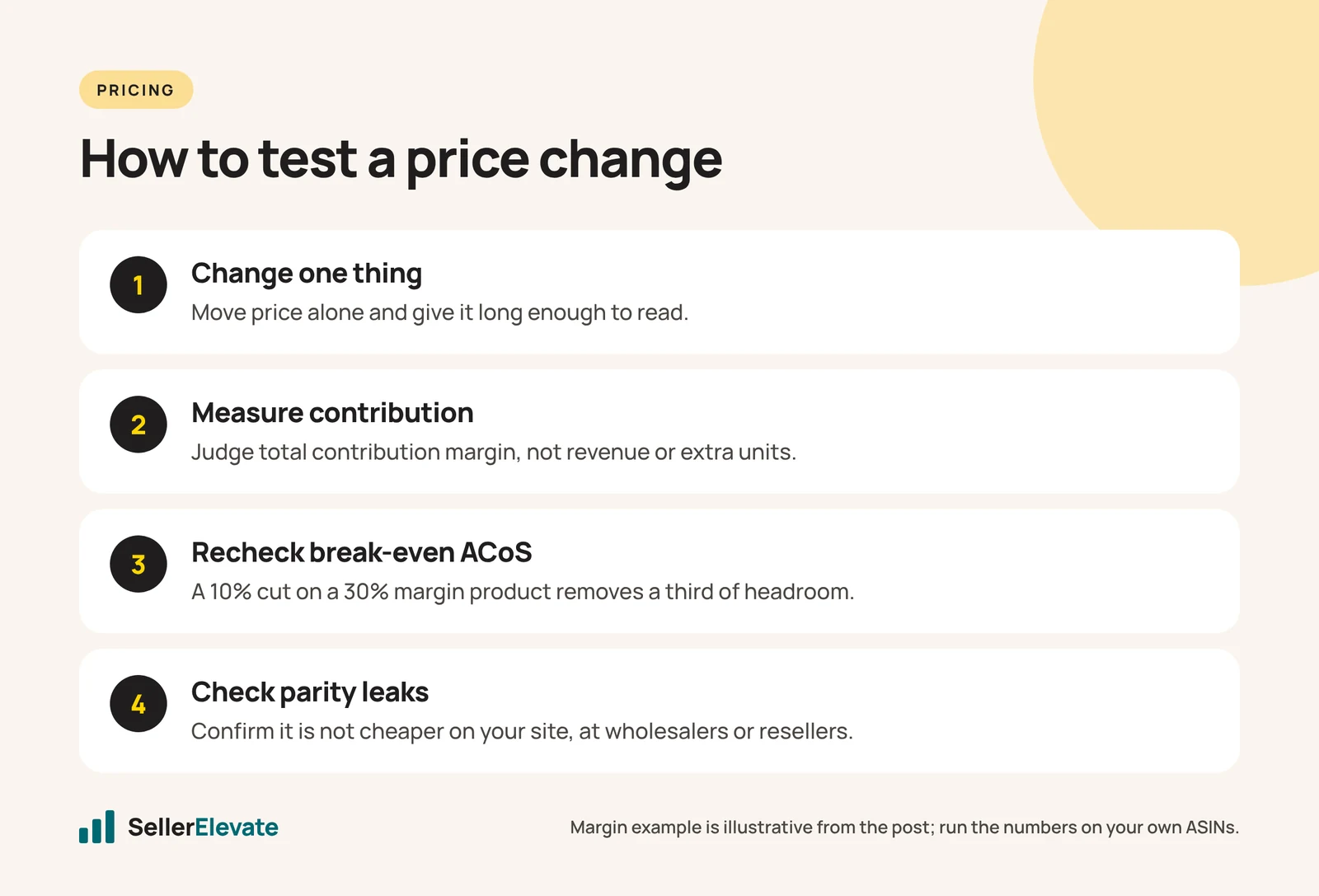
Change one thing, and give it long enough to read. Price and creative moved together tell you nothing about either.
Measure contribution, not revenue. A price cut almost always increases units. That is not the question. The question is whether total contribution margin went up, and whether the rank you bought with the extra velocity is worth the margin you spent buying it.
Check your break-even ACoS at the new price before you commit. A 10% price reduction on a 30% margin product cuts your advertising headroom by a third. If your campaigns were already near break-even, you have just made them unprofitable without touching a bid.
And check for parity leaks first. Before you conclude your price is wrong, confirm the same product is not cheaper on your own website, at a wholesale partner, or through a reseller you forgot about. That is frequently the real problem.
Price, margin and break-even ACoS by ASIN are part of what our free account audit produces — because the number you can afford to bid is decided at the price point, long before anyone opens the campaign manager.
Frequently asked questions
Does price affect who wins the Buy Box on Amazon?
Yes. Amazon names competitive total price as one of four factors in Featured Offer selection, alongside delivery speed and certainty, order experience and stock availability. Price is not the whole story, though: a modestly higher price can still win with a better delivery promise, and a low price can lose outright if you are out of stock.
Why did my Amazon Buy Box suddenly disappear?
A common cause is price parity. If Amazon finds your product listed cheaper elsewhere, the Featured Offer can be suppressed even when your metrics are perfect. Check whether your own DTC site is running a promotion your Amazon listing does not match, and whether a wholesale partner or forgotten reseller is selling it for less.
How does my price affect how much I can bid on Amazon ads?
Your break-even ACoS is simply your contribution margin percentage, so every dollar of margin you give away at the price point is a dollar you cannot spend acquiring customers. A 10% price reduction on a 30% margin product cuts your advertising headroom by a third. Check break-even ACoS at the new price before you commit.
What discount should I offer on Subscribe & Save and Brand Tailored Promotions?
Subscribe & Save lets you fund 0%, 5% or 10%. If the product is replenishable, fund it properly, because a 0% badge rarely earns subscribers. If it is not replenishable, do not enroll it. For Brand Tailored Promotions, lapsed and at-risk customers justify 15 to 20%, while repeat customers justify 5 to 8% at most, on bundles or larger packs.
Get the honest version of your numbers
A free account audit from the person who would actually run your account.