Can you still launch a product into a competitive Amazon niche?
Yes, if your margin can fund the fight. In one recent launch day, the account spent 31.6% of revenue on advertising and still netted 24.8%, because cost of goods was about $3.56 per unit. Plan for at least 50% gross margin in a competitive niche, because margin is your advertising headroom.
Key takeaways
- A competitive-niche launch day showed $4,555.44 in sales, 31.6% TACoS and a 24.8% net margin.
- Launch-phase TACoS typically runs 25 to 40%, falling to 12 to 20% in growth and 5 to 12% at maturity.
- For a competitive niche, 50% gross margin is a sensible planning floor because every point of margin is advertising headroom.
- Partial-day dashboards flatter every ratio, so read seven-day and twenty-eight-day trailing numbers.
- Launch with exact match for ranking, then phrase and broad for reach, then ASIN targeting on top sellers.
“Amazon is too competitive now” is the most common reason brands give for not launching. It is also, as stated, not quite the right objection.
Competition is genuinely brutal — over 70% of sellers now advertise, up from around 40% five years ago, and CPCs rose 18 to 32% in early 2026 with more forecast. But the barrier is not competition itself. It is whether your unit economics can survive the cost of fighting through it.
We launched into a highly competitive niche recently. Most of the team expected it to burn the advertising budget. It is spending heavily and it is profitable, and the reason why is visible in a single day of data.
The day that explains it
A full trading day early in the launch:
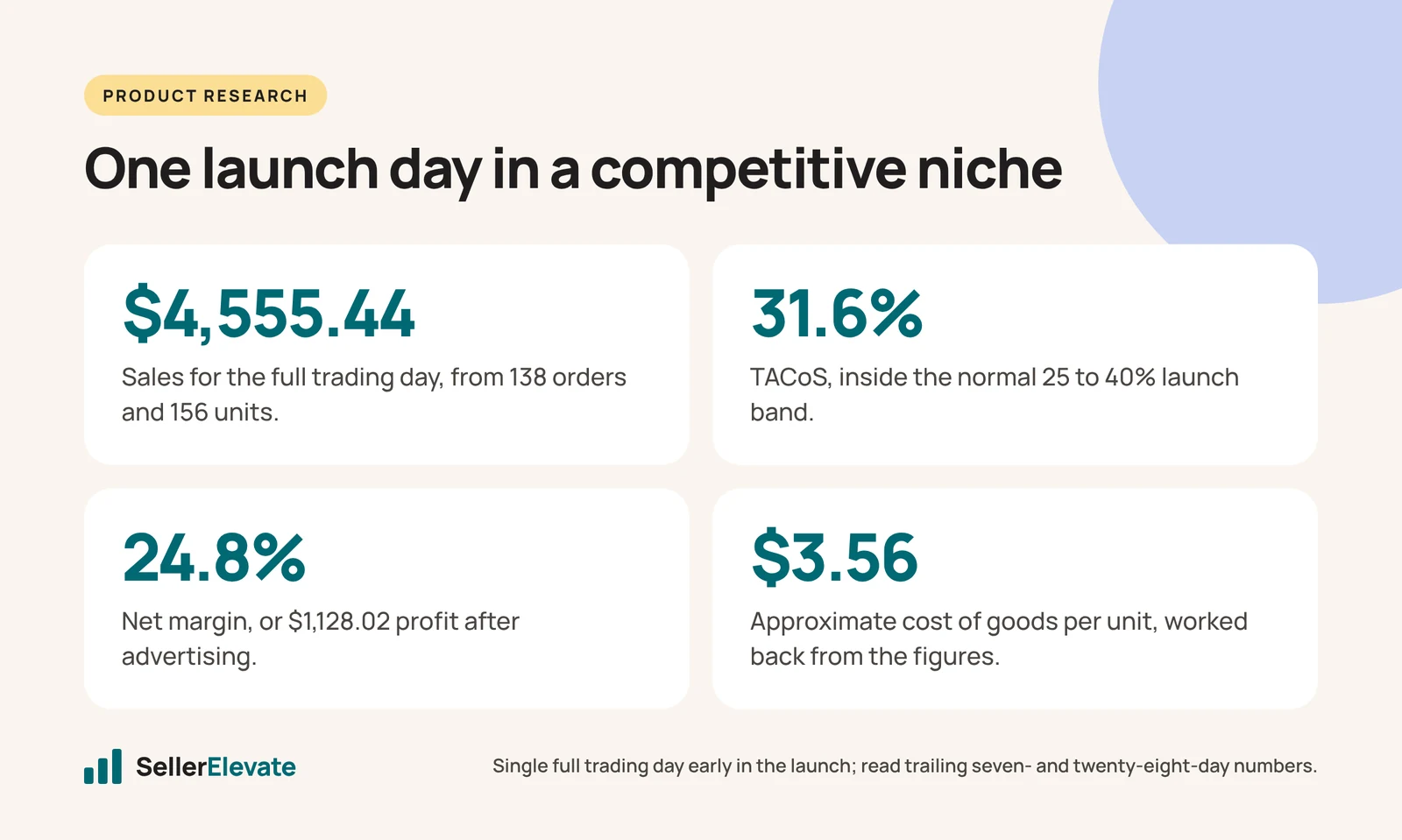
| Sales | $4,555.44 |
| Orders / units | 138 / 156 |
| Advertising | $1,439.34 |
| TACoS | 31.6% |
| Net profit | $1,128.02 (24.8% net margin) |
| Average order value | $33.01 |
| Refunds | 4 (2.9% of orders) |
A 31.6% TACoS is a launch-phase number — the normal band for a product in launch is 25 to 40%, coming down to 12 to 20% in growth and 5 to 12% at maturity. So this account is spending exactly like a launch should.
The remarkable part is the bottom line. Spending nearly a third of revenue on advertising and still netting 24.8%.
What makes a high-TACoS launch profitable?
Work backwards through the figures and the cost of goods comes out at roughly $3.56 per unit on an average selling price of about $29 — about 12% of revenue, meaning a gross margin near 88% before Amazon’s fees and before a dollar of advertising.
That is the whole story.
At that structure you can hand 31.6% of revenue to advertising, absorb Amazon’s referral fee and FBA, take a 2.9% refund rate, and still keep a quarter of the top line. Run the same aggression on a product with 35% gross margin and it loses money on every order.
Which makes the most important advice in a competitive-niche launch the least glamorous one: the launch is won or lost in the sourcing, before a listing exists.
What margin floor should a competitive launch use?
The standard guidance for private label in 2026 is a hard minimum of 20% net margin, set at the research stage. That is the floor for a product that will survive.
For entering a competitive niche, aim much higher. Fifty percent gross margin is a sensible planning floor and higher is better, because the margin is what buys you the right to compete on rank. Every point of gross margin is a point of advertising headroom, and in a contested category the winner is usually whoever can afford to keep bidding after everyone else stops.
That is also why sourcing, shipping, packaging and fee optimisation matter more than any campaign decision. They set the ceiling on everything downstream. Work on cost of goods, FBA fees and freight before launch, because after launch they are close to fixed and you will be optimising bids around a constraint you baked in months earlier.
A caution about reading days
The same screenshot shows the previous day at a 16.8% TACoS and a 42.4% net margin — figures that look dramatically better.
They are not. That day was still in progress when the snapshot was taken. Advertising costs accrue through the day and sales attribution lags, so any partial day flatters every ratio on the page.
This is worth stating because day-level dashboards are addictive and almost entirely misleading. Read seven-day and twenty-eight-day trailing numbers. A single day tells you about yesterday’s weather.
The launch sequence we ran
Exact match first, for ranking. Start with sponsored product exact campaigns on the terms you intend to own. Precision first, deliberately above break-even, because you are buying position rather than immediate profit.
Then phrase and broad, for reach. Once exact is producing and you know which terms convert, widen. Broad without that foundation is just paying to discover things exact would have told you more cheaply.
Then ASIN targeting on top sellers. Get mapped onto the detail pages of established competitors so you appear in their consideration set. Worth remembering that this placement converts worse than search, because you are interrupting someone who already chose — so calculate its break-even separately rather than judging it on blended account ACoS.
How should you choose keywords in a competitive niche?
Relevance over volume, consistently.
The head term in any competitive category is contested by everyone with a budget, which makes it the most expensive traffic available and rarely the best. The terms your competitors overlook are usually longer, more specific, lower volume and far higher intent.
We have seen this concretely: in one German category audit, the highest-relevance keyword in the entire set was a Turkish-language term with 2,055 monthly searches that none of the eleven competitors were properly indexed for. Head term contested by every major brand; genuine buying intent sitting uncontested next to it.
Then place them properly. Title, bullets, description and backend each index differently, and the backend search terms field runs on a 250-byte limit rather than a character count. Getting a keyword into the listing is not the same as getting it indexed in a position that converts.
Testing
Continuous testing is where the compounding happens — images, bullets, price, A+ layout.
One practical note: Amazon’s own experiment tool requires Brand Registry and enough traffic to reach significance, and it covers content elements rather than price. Price testing has to be run sequentially, which means being disciplined about changing one thing at a time and allowing enough volume at each point to mean anything. A week on a low-volume ASIN is noise.
The honest summary
Competition is not the reason most launches fail. Margin is.
A brand with 88% gross margin can fight for rank in a saturated category and profit while doing it. A brand with 35% cannot, and no amount of campaign structure fixes that — it just determines how long the money lasts.
So the question before entering a competitive niche is not whether you can out-execute the incumbents. It is whether your cost of goods lets you stay in the fight long enough to find out.
Working out whether a category is winnable at your cost structure is part of what our product research and audit work produces — including the times the answer is that it isn’t.
Before you commit to a niche, run the six Amazon keyword research prerequisites to check demand, margin and market depth.
Frequently asked questions
What TACoS is normal during an Amazon product launch?
The normal band for a product in launch is 25 to 40% TACoS, coming down to 12 to 20% in the growth phase and 5 to 12% at maturity. A launch day at 31.6% TACoS is spending exactly as a launch should. What matters is whether the margin underneath can absorb that spend and still leave profit.
What gross margin do you need to launch in a competitive niche?
Aim for at least 50% gross margin, and higher is better. The standard private label guidance of a 20% net margin minimum is the floor for a product that survives, but in a contested category the winner is usually whoever can keep bidding after everyone else stops. Every point of gross margin is a point of advertising headroom.
What PPC campaign order works for a competitive Amazon launch?
Start with Sponsored Products exact match on the terms you intend to own, bidding above break-even to buy position. Once you know which terms convert, widen into phrase and broad for reach. Then add ASIN targeting on top sellers to appear in their consideration set, calculating its break-even separately because that placement converts worse than search.
Why are single-day Amazon numbers misleading?
A partial day flatters every ratio. Advertising costs accrue through the day and sales attribution lags, so a snapshot taken mid-day can show a much lower TACoS and higher margin than the day ends with. In this launch, an in-progress day showed 16.8% TACoS and 42.4% net margin. Read seven-day and twenty-eight-day trailing numbers instead.
Get the honest version of your numbers
A free account audit from the person who would actually run your account.