What should my Black Friday 2026 strategy be? Should I discount or not?
Discount only where the extra units will more than replace the margin you give up, after Q4 fees and ads. In our hypothetical $29.99 example, a 20% discount needs 1.65x the units just to break even before ads. Many products deserve a smaller deal, or none.
Key takeaways
- A discount pays for itself only when extra units replace the margin given up on units you would have sold anyway.
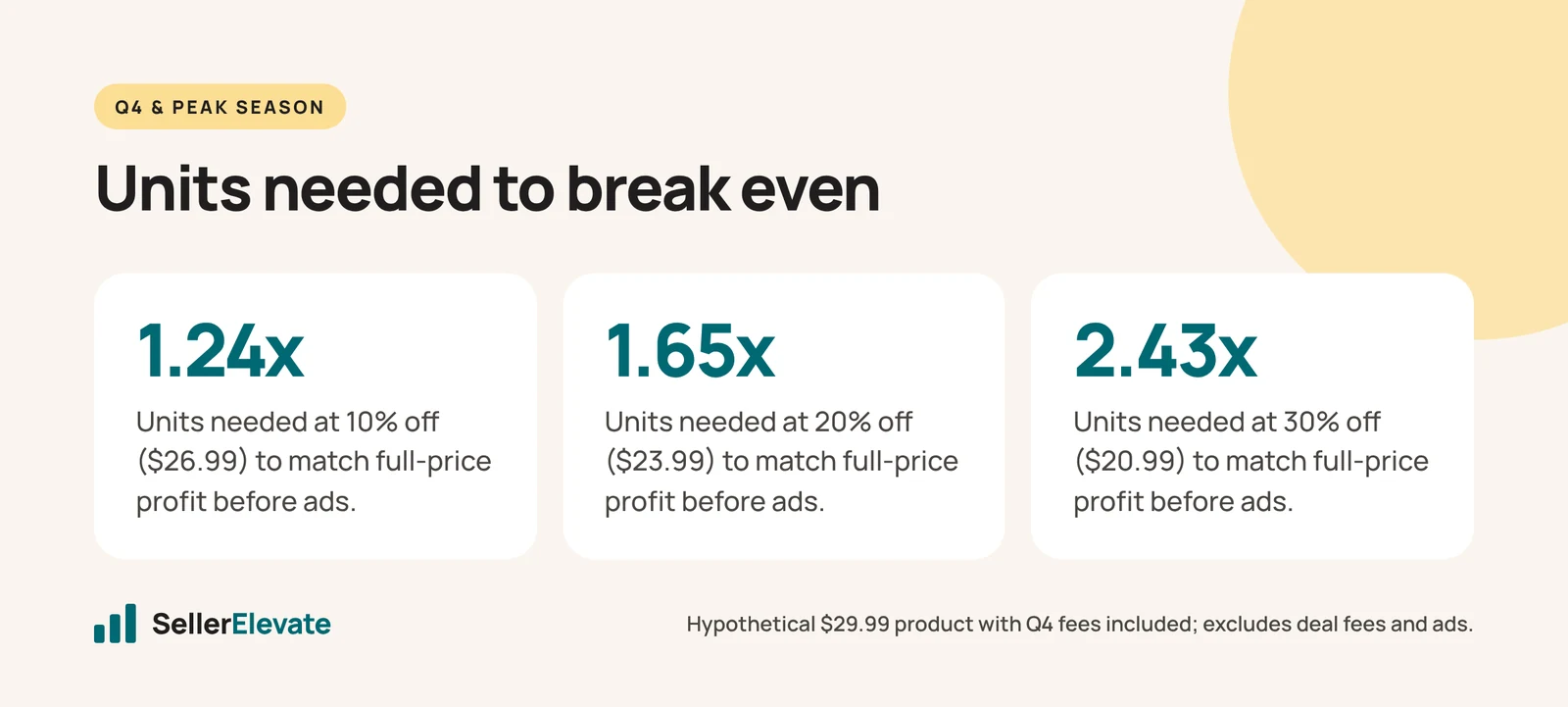
- In our hypothetical $29.99 example, 20% off needs 1.65x the units and 30% off needs 2.43x just to break even before ads.
- eMarketer expects US holiday ecommerce to grow 6.6% in 2026, with price-sensitive shoppers more pessimistic than high earners.
- Since April 23, Amazon only shows a strikethrough when the List Price is backed by real sales or another retailer's recent price.
- Sort the catalog into deal, visibility only and hold price before the October 20 deal deadline.
Discount for Black Friday 2026 only on products where the extra units you expect to sell will more than replace the margin you give away, after Q4 fees and ad costs. For many Amazon products that means a smaller discount on fewer ASINs than last year, or no deal at all on some of them.
That is not a cautious answer for the sake of it. The 2026 numbers point the same way: modest ecommerce growth, shoppers split by income, higher Q4 costs, and Amazon rules that make inflated “discounts” both less visible and riskier. Below is how we are deciding, product by product, with the break-even math you can run yourself.
What does the 2026 holiday season look like?
The forecasts we trust are steady rather than exciting. eMarketer expects US holiday retail to grow 2.6% and ecommerce 6.6% in 2026, similar to 2025.
The split by income is what matters for pricing. Salesforce’s July forecast found 52% of low-income and 50% of middle-income consumers feeling pessimistic, against 36% of high-income consumers. It also found 49% of low-income consumers buying less, while 32% of high-income consumers are buying more. Salesforce also predicts that 20% of 2026 holiday ecommerce traffic will come from AI chat agents.
Put together: price-sensitive shoppers will compare harder, and some of that comparing will be done by AI tools that read price history. Shoppers who are less price-sensitive will buy anyway. A blanket discount gives money to the second group in order to win the first.
The calendar is fixed. Black Friday is November 27, 2026 and Cyber Monday is November 30. Amazon’s Black Friday Week and Cyber Monday deal submissions close on October 20.
Why is discounting riskier on Amazon this year?
Three changes make a discount cost more or show less than it used to.
Q4 fees. Holiday peak fulfillment fees add an average of $0.32 per unit from October 15 to January 14, 2027, and the 3.5% fuel and logistics surcharge applies on top. Standard-size storage is $2.40 per cubic foot in October to December. We break all of this down in Q4 2026 Amazon fees.
Deal fees. Lightning Deals, Best Deals and Prime Exclusive Discounts cost $100 per promotion plus 1.5% of promotional sales, with the variable part capped at $5,000, per EcomCrew.
Reference price rules. Since April 23, a List Price only produces a strikethrough if the product actually sold at that price as the Featured Offer, or another retailer recently offered it at that price. PPC Land reports that deal discounts need to be at least 5% off the 30-day lowest non-promotional price, at least 5% off the current price, and at least 5% off a validated reference price where one exists. Without a validated reference price, the discount shows no strikethrough or savings percentage at all. And since May 18, if a product sits below its non-promotional median price for more than half of a 90-day period, promotional sales count toward Typical Price. Run discounts too often and your “regular” price drifts down to meet them.
EcomCrew also reports Amazon’s warning that misleading reference prices can lead to removal of the Featured Offer or suspension of selling privileges. That is the opposite of what a Black Friday deal is for. For the full detail see our strikethrough and List Price explainer.
When does a Black Friday deal pay for itself?
A deal pays for itself when the profit on the extra units is larger than the profit you give up on the units you would have sold anyway. The quick way to check is the break-even lift:
Units needed at deal price ÷ units at full price = profit per unit at full price ÷ profit per unit at deal price.
Here is a hypothetical example using the same $29.99 product as our Q4 fees post: a 15% referral fee, a $3.80 base FBA fee, $8.00 landed cost, and Q4 peak fees, fuel surcharge and storage included.
| Discount | Deal price | Profit per unit before ads | Units needed to break even |
|---|---|---|---|
| None | $29.99 | $12.99 | 1.00x (baseline) |
| 10% | $26.99 | $10.44 | 1.24x |
| 20% | $23.99 | $7.89 | 1.65x |
| 30% | $20.99 | $5.34 | 2.43x |
At 20% off, you need to sell 65% more units just to make the same profit before ads. At 30% off, you need well over twice the units. And that is before the deal fee and any extra ad spend, both of which raise the bar further.
Now ask honestly: did your last 20% deal lift units by 65% or more, net of the units you would have sold anyway in the same week? Some products clear that easily. Many do not. Prime Big Deal Days on October 6 to 7 is the best test you will get before the October 20 deadline; our Prime Big Deal Days playbook covers the five numbers to pull on October 8.
Which products should get a deal, and which should not?
We sort the catalog into three groups before submitting anything.
| Group | Typical profile | BFCM approach |
|---|---|---|
| Deal | High margin, giftable, strong conversion, enough inventory | Submit a deal by October 20 at a depth your break-even supports |
| Visibility only | Average margin, steady demand | No deal; lean on ads, coupons or a modest price change where margin allows |
| Hold price | Low margin, low price, bulky or low stock | No discount; keep the Featured Offer and protect profit |
A few things shift products between groups.
- Inventory. A deal on a product that will run out before your Black Friday stock arrives just sends shoppers to a competitor. Check your arrival dates against the Black Friday 2026 inventory deadlines first.
- Repeat purchase. A consumable that brings customers back can justify a deeper first-order discount than a one-off gift. Be honest about your actual repeat rate, not the one you hope for.
- Ranking. A deal that lifts sales velocity can improve organic rank going into December. That is a real benefit, but it is the hardest to measure, so do not use it to justify a deal that loses money on paper by a wide margin.
How much should you spend on ads during BFCM?
Plan Black Friday ad spend from your Q4 margin, not your summer one. If your profit per unit at the deal price is $7.89, your break-even ACoS on that product is far lower than it was at full price in September.
Spend that is pointed at a listing that converts can scale hard. On one SKU we have managed, $358K of ad spend ran at 4.00 ROAS with TACoS under 10%. That only works because the product’s economics and conversion were already strong, and because the automation was watched rather than trusted blindly. The same spend pointed at a deal that does not lift conversion just makes a thin margin thinner.
What we'd do before October 20
- Build the break-even table for every ASIN you are considering, using your own fees and costs. Anything that needs more than about 1.5x units at the planned discount needs a strong reason to stay on the list.
- Check reference prices. Confirm which ASINs still show a strikethrough. A deal with no visible saving is a price cut no one notices.
- Use Prime Big Deal Days data to set realistic lift expectations by product.
- Sort the catalog into deal, visibility only and hold price.
- Submit deals by October 20, then set ad budgets and ACoS targets from the deal-price margin.
- Plan December. Some of the best Q4 profit comes after Cyber Monday at full price. Do not train shoppers to wait for the next deal.
If you would like us to run the numbers across your catalog, our account management team does this every Q4.
Frequently asked questions
How do I calculate the break-even for an Amazon deal?
Divide your profit per unit at full price by your profit per unit at the deal price. The result is how many times your normal units you must sell to make the same profit. In our hypothetical example, $12.99 divided by $7.89 gives 1.65x at 20% off. Add deal fees and extra ad spend on top.
How deep does an Amazon deal discount have to be?
PPC Land reports that deal discounts need to be at least 5% off the 30-day lowest non-promotional price, at least 5% off the current price, and at least 5% off a validated reference price where one exists. Without a validated reference price, no strikethrough or savings percentage shows. Confirm current rules in Seller Central.
Can running too many promotions hurt my Amazon price?
Yes. Since May 18, if a product sits below its non-promotional median price for more than half of a 90-day period, Amazon counts promotional sales toward Typical Price. Run discounts too often and your reference price drifts down, so your Black Friday saving looks smaller to shoppers.
Should I raise ad spend on Black Friday if I am running a deal?
Only within your deal-price margin. A deal lowers profit per unit, so your break-even ACoS is lower than in September. Raise budgets on campaigns and targets that already convert, and set ACoS targets from the deal-price margin, not your summer one.
Sources
- eMarketer: It’s never too early: what’s ahead for the 2026 holiday season (Feb 23, 2026)
- Salesforce: 2026 holiday predictions (Jul 20, 2026)
- EcomCrew: Amazon Publishes Q4 2026 Deadlines: Same Fees, Earlier Inventory Cutoffs (Jul 7, 2026)
- EcomCrew: Amazon cracks down on inflated discounts with new pricing rules (Apr 6, 2026)
- PPC Land: Amazon’s fake discount crackdown, List Price rules tighten April 23 (Apr 1, 2026)
- AMZ Prep: Amazon seller updates August 2026 (Sep 4, 2026)
Get the honest version of your numbers
A free account audit from the person who would actually run your account.