Are Lightning Deals worth it on Amazon?
Sometimes. A Lightning Deal is worth it when the discounted units are profitable on their own or you need to move stock fast. Since June 2, 2025, non-peak deals cost $70 per day plus 1.0% of deal sales, but the discount usually costs far more than the fee, and research found the rank gain was only 1.3% to 1.6%.
Key takeaways
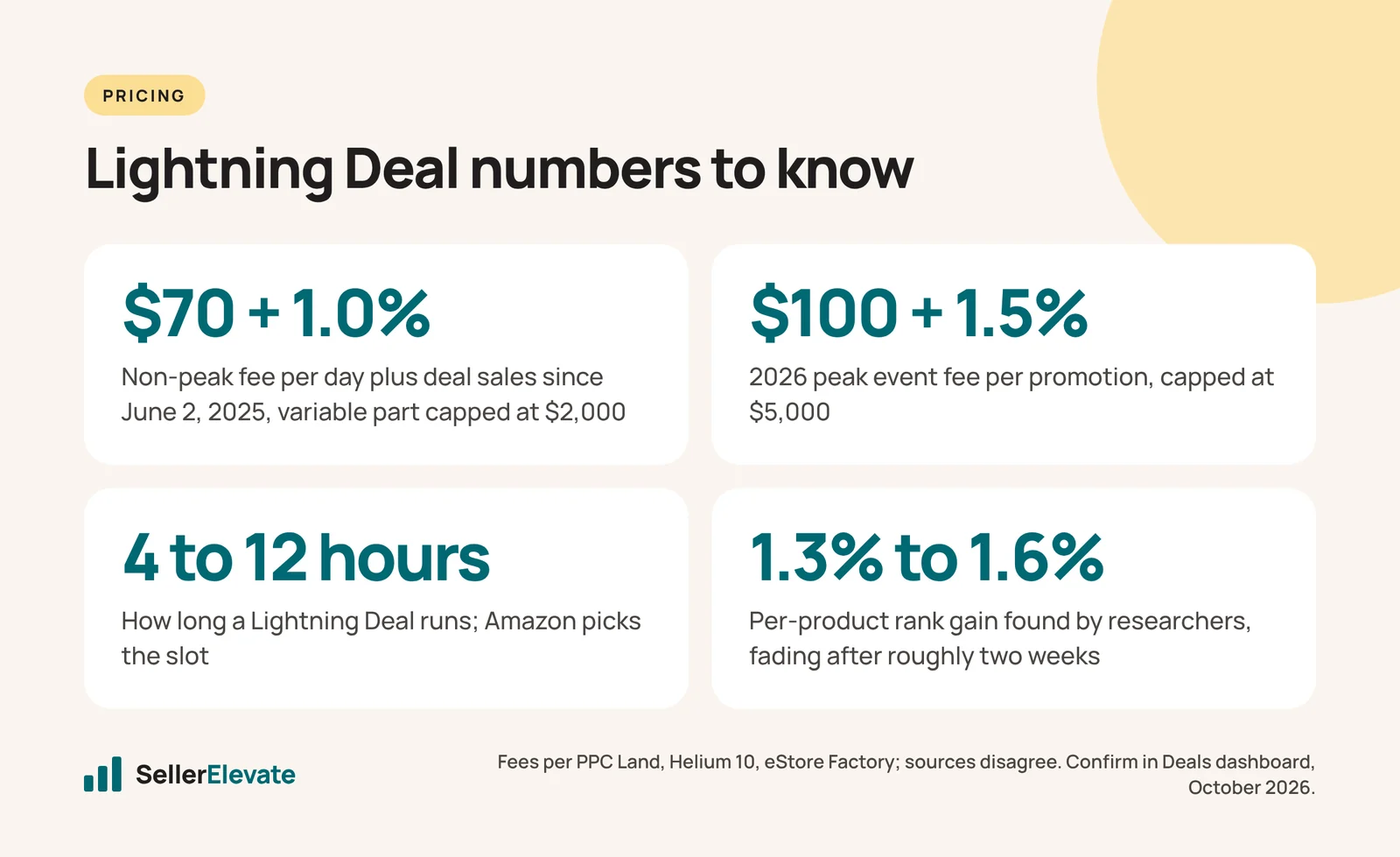
- Since June 2, 2025, non-peak Lightning Deals cost $70 per day plus 1.0% of deal sales, with the variable part capped at $2,000 per deal.
- For 2026 peak events the fee is $100 per promotion plus 1.5% of promotional sales, capped at $5,000.
- In a hypothetical 300-unit deal, the discount gave away $2,040 of profit while the fee was $166.
- A study of 2,451 products found the per-product rank gain was only 1.3% to 1.6% and faded after roughly two weeks.
- Measure units, organic rank, sessions and TACoS for 14 days before and after the deal.
Sometimes, but rarely for the reason sellers expect. A Lightning Deal is worth running when the discounted units are profitable on their own or you have a specific reason to move volume fast; it is a weak bet if you are paying for it hoping the spike will lift your organic rank for months afterwards.
The fee is now the small part of the decision. The discount is the big part, and the “rank boost” is smaller and shorter than most forum threads assume. Here is how we model it, and what we measure afterwards.
What does a Lightning Deal cost in 2026?
The fee structure changed in 2025, and older articles still quote the old numbers, so check the date on anything you read.
According to PPC Land’s Lightning Deal explainer (September 2026), Amazon charged a flat $150 per deal on ordinary days and $500 at peak events before June 2, 2025. From June 2, 2025, non-peak deals cost $70 per day plus 1.0% of deal sales, with the variable part capped at $2,000 per deal. For the 2026 peak events (Prime Big Deal Days and Black Friday week), the fee is $100 per promotion plus 1.5% of promotional sales, capped at $5,000, with a $50 reduction for early submission. Helium 10 and eStore Factory report the same $70 plus 1% non-peak structure.
Sources do not fully agree. Jungle Scout’s guide, updated in July 2026, still lists $150 per deal and $300 to $500 at peak. They also differ on eligibility: Jungle Scout cites a 3.5-star seller rating and a minimum 15% discount, while PPC Land says Amazon’s seller guide requires an overall rating of at least four stars and notes that published minimum discounts range from 10% to 20%. Treat these as as of October 2026 and confirm the fee preview and discount requirement in the Deals dashboard before you submit.
Other mechanics that matter for the math:
- A Lightning Deal runs for four to 12 hours, and Amazon, not you, picks the slot. Jungle Scout notes you can see the scheduled time in the Deals dashboard one week before it runs.
- Fees are not refunded if the deal underperforms.
- Since April 23, 2026, the struck-through reference price must be backed by actual sales or other retailers’ prices (PPC Land). If your “was” price is shaky, the deal may not show the saving you expect. We covered that rule in our strikethrough price post.
Does a Lightning Deal actually boost organic rank?
A little, briefly. The best evidence we have seen is a study PPC Land summarizes by Pingping Tang, Charles Munson and Zhezhu Wen, covering 2,451 products and 316,939 daily observations between October 2023 and February 2024.
Comparing products within a category, deal products showed a 15% rank improvement. But when the researchers compared each product with itself over time, which is the fairer test, the gain fell to between 1.3% and 1.6%, and it faded after roughly two weeks. They also found the benefit rose with repeated deals up to around 11 deals over five months, then declined, which they put down to fatigue with scarcity cues.
That matches what we see in accounts. A deal day produces a sales spike and a temporary Best Sellers Rank jump. Whether anything sticks depends on what the listing does with the extra traffic: new reviews, better conversion on keywords you rank for, and whether your ads keep the momentum. If your rank only holds while you are paying for it, that is the pattern we describe in renting rank instead of earning it.
So do not justify a deal on a long-term rank effect. Justify it on the units, and treat any rank lift as a bonus you measure.
How do you model the deal economics?
Work it out per unit first, then for the deal as a whole. Here is a hypothetical example: a product with a $40 regular price, $8 landed cost, a $7 FBA fee and a 15% referral fee, run at 20% off.
| Regular day | Deal day | |
|---|---|---|
| Price | $40.00 | $32.00 |
| Referral fee (15%) | $6.00 | $4.80 |
| Landed cost + FBA fee | $15.00 | $15.00 |
| Profit per unit before ads and deal fee | $19.00 | $12.20 |
Now the deal. Say it sells 300 units at $32, which is $9,600 of deal sales. On a non-peak day the fee is $70 plus 1% of $9,600 ($96), so $166, or about $0.55 a unit. Deal profit is 300 × $12.20 minus $166, which is $3,494.
Notice where the cost went. The fee is $166. The discount gave away $6.80 of profit on every unit, or $2,040 across 300 units. The discount costs more than 12 times the fee.
The question that decides whether the deal was worth it is how many of those 300 units were incremental. If the product normally sells 20 units a day, some deal buyers would have bought at full price that day or the following week. A quick rule:
- Estimate the units you would have sold anyway during the deal window and the week after (deals pull demand forward).
- Multiply those units by the profit you gave up per unit ($6.80 here). That is your cannibalization cost.
- Add the deal fee.
- Compare the total with the profit on the genuinely new units.
If the deal only breaks even on that basis, it is a branding or inventory decision, not a profit decision. That can still be a good reason, as long as you call it what it is.
When is a Lightning Deal the right call?
Use these decision rules:
- Run it if your discounted unit profit is still healthy (in the example, $12.20 is a reasonable margin), you have the stock, and your listing converts well. A converting listing turns deal traffic into reviews and ranking signals.
- Run it to clear aged or excess inventory before storage costs climb, where the alternative is a removal or liquidation at a worse price.
- Skip it if the deal price leaves you near break-even before ads. The fee is small, but you will likely still be running ads during and after, and those eat what is left.
- Skip it if your reference price might not qualify under the April 2026 rule. A deal without a visible saving loses much of its pull.
- Skip it if the product has fewer reviews than the competitors around it. Deal traffic that lands on a weak listing converts poorly, and you pay for the attention anyway. That is the same lesson as in PPC Is an Amplifier, Not a Fix: fix the listing first.
- Think twice at peak. The fee is higher ($100 plus 1.5%), every competitor is discounting, and shoppers compare deals side by side. Our Prime Big Deal Days playbook covers the event-specific calls.
What should you measure in the two weeks after the deal?
Set the baseline before the deal: the 14 days before it runs. Then track the same numbers for the 14 days after. The research suggests two weeks is roughly when any effect fades, so that is the right window.
- Daily units, split organic and ad-attributed. Total units can rise just because you were advertising harder.
- Organic rank for your top five keywords. Check at the same time each day.
- Sessions and unit session percentage (from Business Reports). A real lift shows up as more sessions at a similar or better conversion rate.
- Best Sellers Rank, but treat it as noisy. It reacts to the spike and decays quickly.
- TACoS. If total sales are up but TACoS is up as well, you bought the result.
- Reviews gained in the 30 days after, since the review effect lags.
- Price after the deal. Check that your regular price and the reference price display returned as expected.
If units in days 8 to 14 are back at baseline, the deal was a one-day sales event, nothing more. Judge it on the deal-day profit alone.
What we'd do this week
If you are deciding on a Lightning Deal for Q4:
- Open the Deals dashboard, pick the ASIN, and read the actual fee and minimum discount it shows you. Do not rely on any blog figure, including ours.
- Fill in the per-unit table above with your real landed cost, FBA fee and referral fee.
- Estimate the units you would have sold anyway, and calculate the cannibalization cost.
- Check your reference price history against the April 2026 rule.
- If the numbers work, submit early to qualify for the $50 reduction where it applies.
- Write down your 14-day baseline today, so you have something to compare against.
If you want a second opinion on deal economics or ad pacing around an event, our Amazon account management team builds these models for clients before every peak period.
Frequently asked questions
How long does an Amazon Lightning Deal run?
A Lightning Deal runs for four to 12 hours, and Amazon chooses the exact slot rather than the seller. Jungle Scout notes the scheduled date and time appears in the Deals dashboard one week before the deal runs, so plan stock and ad budgets around that window once it shows.
Is the Lightning Deal fee refunded if the deal does not sell?
No. Amazon does not guarantee sales from a deal and does not refund deal fees, according to Jungle Scout. Under the current structure the fixed part of the fee is charged regardless, so a deal on a weak listing can cost money with little to show for it.
What reference price does a Lightning Deal show?
Since April 23, 2026, the struck-through reference price shown to shoppers must be backed by actual sales or other retailers' prices, according to PPC Land. If your list price was rarely charged, the deal may not display the saving you expect, which weakens its pull.
How many Lightning Deals should a product run?
There is no fixed rule. The Tang, Munson and Wen study found benefits rose with repeated deals up to around 11 deals over five months, then declined, which the authors linked to fatigue with scarcity cues. Judge each deal on its own profit first.
Sources
- PPC Land: Lightning Deal (September 20, 2026)
- Jungle Scout: Amazon Lightning Deals (updated July 22, 2026)
- Helium 10: Amazon increases coupon fees 2025 (March 27, 2025)
- eStore Factory: Amazon coupon fees 2026 (September 9, 2026)
Get the honest version of your numbers
A free account audit from the person who would actually run your account.