Why is my Amazon ACoS going up every year?
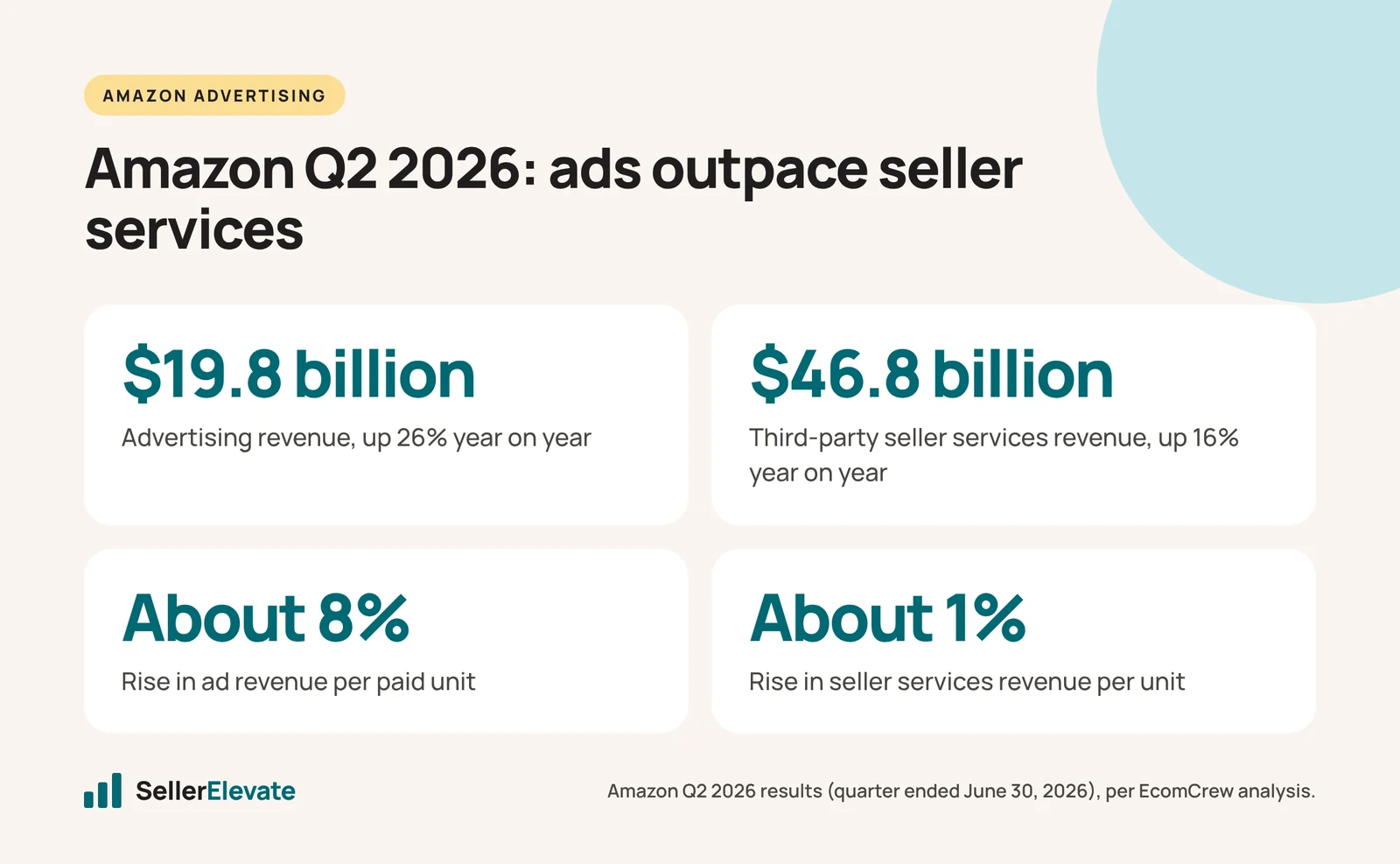
Mostly because more of the competition for each sale runs through ads. In Q2 2026 Amazon's ad revenue grew 26% to $19.8 billion while third-party seller services grew 16%, and ad revenue per paid unit rose about 8%. More ad money per unit sold means higher costs per order unless conversion improves.
Key takeaways
- Amazon's Q2 2026 ad revenue was $19.8 billion, up 26%, against $46.8 billion in third-party seller services, up 16%.
- Ad revenue per paid unit rose about 8% year on year, while seller services revenue per unit rose about 1%.
- For a hypothetical $30 product with a 35% margin, an 8% rise in ad cost per order can turn a profitable ad sale into a loss.
- Raising conversion rate lowers cost per order as much as a lower CPC, and it is the lever you control.
- Judge ads on TACoS and net profit, not ACoS alone.
Your ACoS keeps rising mostly because more of the competition for each Amazon sale now runs through paid ads, and Amazon’s own numbers show it. In Q2 2026, Amazon’s ad revenue grew 26% while third-party seller services grew 16%, so the ad cost attached to each unit sold went up faster than everything else sellers pay.
That is a structural trend, not a sign you are doing PPC wrong. But it does mean the habit of fixing a rising ACoS by raising bids gets more expensive every year. Here is what the numbers say and what we would do about it.
What do Amazon's Q2 2026 numbers actually show?
Amazon’s second quarter ended June 30, 2026. EcomCrew’s breakdown (published August 3) pulls out the figures that matter to sellers:
| Q2 2026 figure | Amount | Change vs Q2 2025 |
|---|---|---|
| Advertising revenue | $19.8 billion | +26% (from $15.7 billion) |
| Third-party seller services | $46.8 billion | +16% (from $40.3 billion) |
| Online stores | $70.4 billion | +15% |
| Worldwide paid units | n/a | +17% |
| Ad revenue per paid unit | n/a | about +8% |
| Seller services revenue per unit | n/a | about +1% |
Andy Jassy described it as “another strong quarter with 26% year-over-year growth” for advertising, according to exchange4media.
One line of our own arithmetic from those figures: ad revenue was about 39% the size of seller services revenue in Q2 2025, and about 42% in Q2 2026. Fees per unit barely moved. Advertising is where the extra cost per unit is coming from.
Why does that push your ACoS up?
ACoS is ad spend divided by ad-attributed sales. It rises when you pay more per click, convert fewer of those clicks, or sell at a lower price. The Amazon-wide trend mostly works through the first one.
A few things push in the same direction:
- More sellers bidding on the same searches. Units grew 17%, but the ad money chasing those units grew 26%. More budget per unit means more bidders per auction.
- More of the page is paid. As sponsored placements take more room, a listing that used to win clicks organically needs ads to hold the same position. We called this renting your rank in an earlier post.
- New paid surfaces. Amazon keeps adding formats such as Sponsored Prompts, Sponsored Products video and the new Collections format that is replacing Product Collection ads. Each one is another place to compete.
- How the auction prices clicks. The FTC and 22 states allege that a hidden reserve price meant advertisers increasingly paid close to their own bids from 2019 onward. Amazon denies this and says inflation-adjusted CPC was flat from 2019 to 2024 while conversion rates rose 24%. We cover both sides in our post on the FTC ad pricing lawsuit.
Notice the tension there. Amazon says clicks did not get more expensive in real terms. Its earnings say the ad revenue per unit sold rose about 8% in a year. Both can be true if more clicks are being bought per sale, or more of each sale is attributed to ads. For a seller the result is the same: more ad cost sitting on each unit.
How much does an 8% rise actually hurt?
A hypothetical example. Take a $30 product with a 35% margin before advertising, so $10.50 of profit per unit to spend on acquiring the sale.
- At a $1.00 CPC and a 10% conversion rate, each ad-driven order costs $10.00 in clicks. ACoS is 33.3% and you keep $0.50.
- If your ad cost per order rises 8%, in line with Amazon’s ad revenue per unit, each order costs $10.80. ACoS is 36%, and every ad-driven sale now loses $0.30.
Nothing changed in your account. The product is the same, the listing is the same, and the bids are the same. A thin margin simply stopped covering the going rate. This is why we say ACoS targets set in 2023 are probably wrong for 2026.
Now run the same example with a better listing. If the conversion rate rises from 10% to 12%, the cost per ad-driven order at a $1.08 CPC falls to $9.00, ACoS drops to 30%, and you keep $1.50 per order even after the price rise. Nobody can promise a two-point conversion gain, but the arithmetic shows where the leverage is: conversion rate moves cost per order as much as CPC does, and conversion is the part you control.
Is a rising ACoS always a problem?
No. ACoS only looks at ad-attributed sales. If ads lift your organic rank and total sales, a higher ACoS can come with higher profit. That is why we look at TACoS (ad spend as a share of total sales) and net profit first.
Two published examples from our own work:
- One client spent 25% more on ads after a listing rebuild, and net profit rose 81.5% from Q4 2024 to Q1 2025. Ad spend went up; TACoS went down. The full story is in PPC is an amplifier, not a fix.
- On another account we ran $358K of ad spend on one SKU at 4.00 ROAS with TACoS under 10% (details here).
Neither of those came from cutting spend. They came from making the spend land on a listing that converts. If you want the longer version of why “what’s a good ACoS” has no single answer, see seven PPC arguments and what each one depends on.
How do you grow profit when ads keep getting more expensive?
You cannot change Amazon’s ad growth. You can change what each click is worth to you. In rough order of impact:
- Raise conversion rate before raising bids. Better images, clearer bullets, more reviews and a sharper price all lower your cost per order at the same CPC. Listing work is usually the cheapest margin you can buy, which is why our listing optimization work comes before bid changes.
- Recalculate break-even ACoS every quarter. Use current fees, landed cost and price. Many accounts are still bidding to a target nobody has checked since before the last fee change.
- Separate branded, generic and competitor campaigns. Branded traffic is cheap and inflates blended ACoS figures. Mixing them hides where money is lost.
- Bid from margin, not from rank anxiety. Set a maximum CPC per target from conversion rate and margin, and accept losing some auctions.
- Cut targets that never convert. Search term reports show them. Negate them.
- Fix the economics if they do not work. Sometimes price, pack size or landed cost is the real problem. Ads cannot solve a product that does not make money at its price.
- Measure total profit, not ACoS. Track TACoS and contribution margin by ASIN monthly.
What we'd do this week
- Pull ASIN-level profit after fees and ad spend for the last 90 days. Rank by profit, not by sales.
- Recalculate break-even ACoS for your top 10 ASINs at today’s price and fees, as of October 2026. Confirm fee figures in Seller Central.
- Compare current bids on your top 20 targets with the maximum CPC those ASINs can afford.
- Pick the one ASIN with the worst conversion rate among high spenders and fix the listing before touching its bids.
- Set a monthly TACoS and profit review with whoever runs your ads.
If your ACoS has climbed for a year and the response has always been more bids, an account audit is usually faster than another quarter of guessing.
Frequently asked questions
What is a good ACoS on Amazon in 2026?
There is no single number. A good ACoS is one below your break-even ACoS, which is your margin before advertising as a percentage of price. A product with a 35% margin breaks even at 35% ACoS. Recalculate it every quarter, because fees, landed costs and prices change, and targets set years ago are often wrong.
What is the difference between ACoS and TACoS?
ACoS is ad spend divided by ad-attributed sales. TACoS is ad spend divided by total sales, including organic. TACoS shows whether advertising is lifting the whole business. A rising ACoS with a falling TACoS can be healthy, because ads may be driving organic rank and sales that ACoS does not count.
Is the FTC lawsuit the reason my ACoS went up?
It may be part of the picture, but it is an allegation, not a finding. The FTC and 22 states allege a hidden reserve price raised what advertisers paid. Amazon denies it and says inflation-adjusted CPC was flat from 2019 to 2024. The broader trend of ad revenue outgrowing seller revenue applies either way.
Should I cut ad spend if my ACoS keeps rising?
Not across the board. Cut targets that never convert and products whose economics do not work at their price. Fix conversion on high-spend listings first. One client spent 25% more on ads after a listing rebuild and net profit rose 81.5%, because the spend landed on a page that converted.
Sources
Get the honest version of your numbers
A free account audit from the person who would actually run your account.